Chapter 4: Some lessons from current practice
The bombed cities: 388–391
The bedlam of traffic, apart from the convoys, had been forgotten. Indeed, when traffic of more substantial volume developed, the bedlam was even pleasurable, as it offered a continuing reminder of the end of the war.
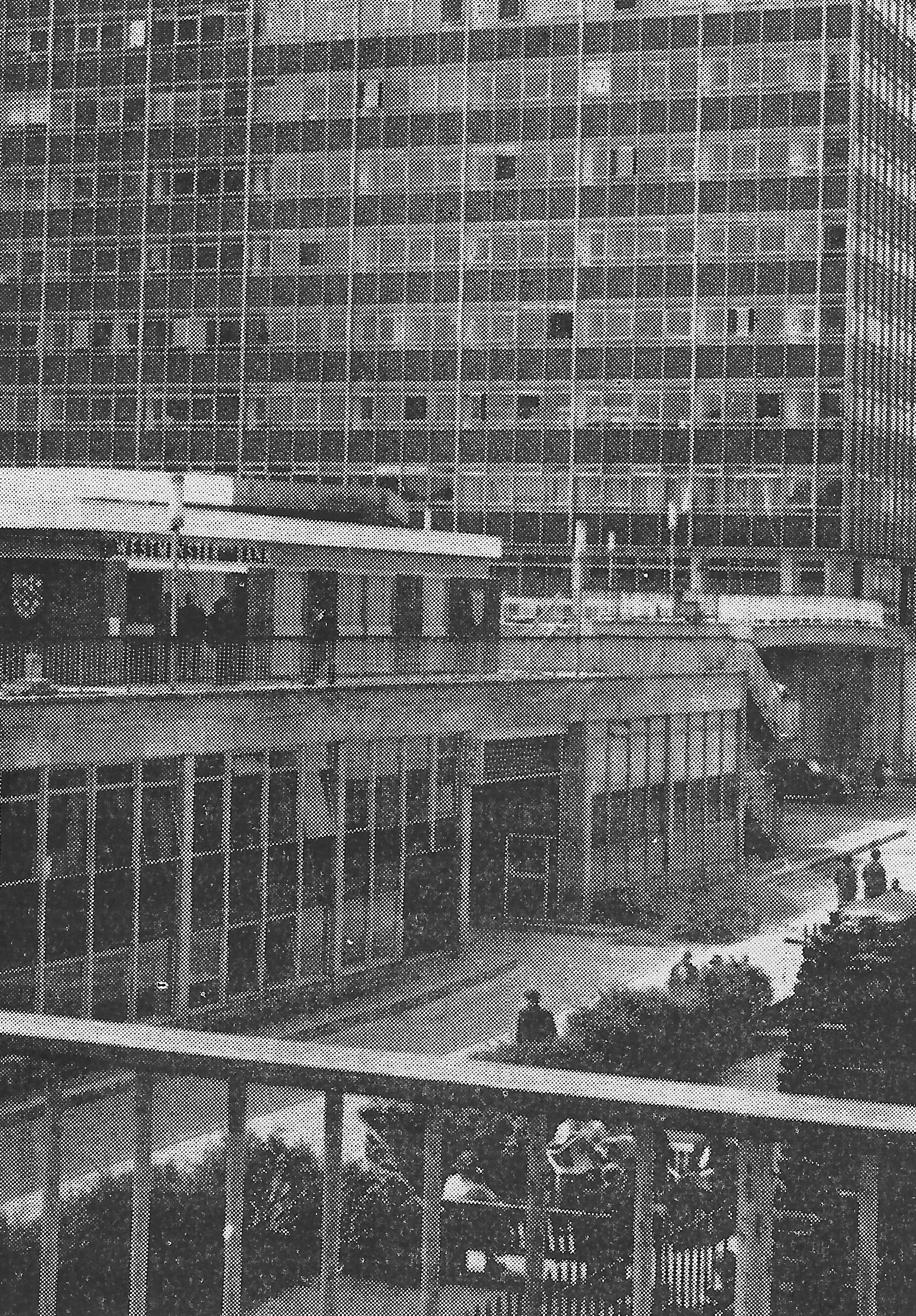
Fig. 217 The Barbican redevelopment in the City of London. Still under construction, but the photograph shows clearly the beginning of the upper level pedestrian system. 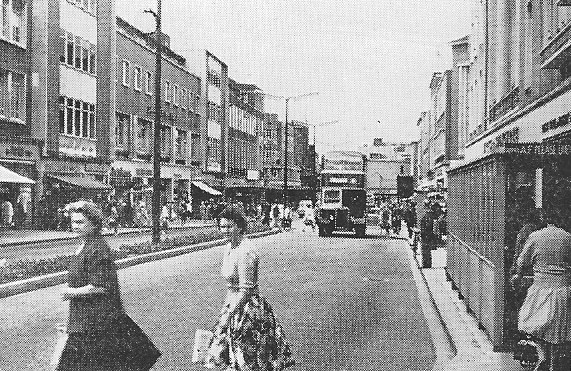
Fig. 218 Exeter. The High Street as reconstructed after war-damage to standard dual carriageway form. 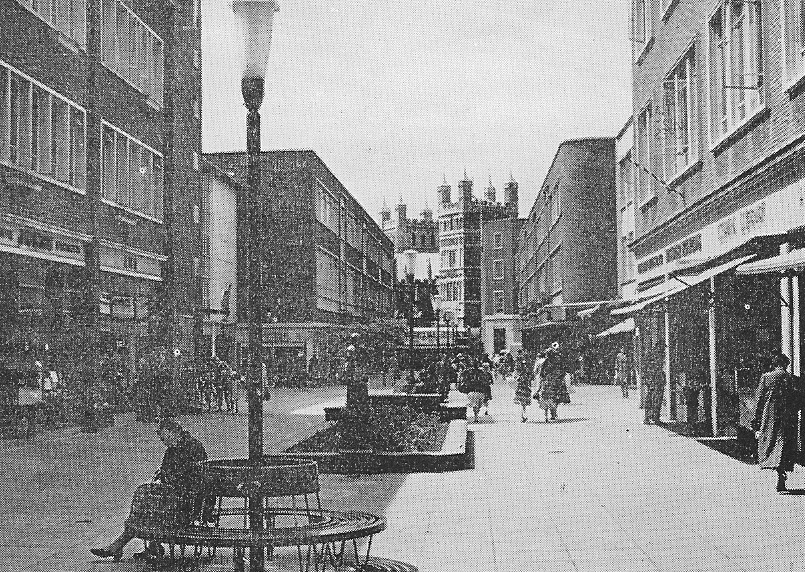
Fig. 219 Exeter. The new pedestrian shopping street (Princesshay), 'foolproof against the worst that traffic can dỏ.
The bombed cities
388When we examined the blitzed-city reconstructions we found a generally disappointing picture in the failure to develop adequate environmental concepts, though Coventry, Barbican in the City of London, and the large reconstruction in London’s Bast End (Stepney-Poplar), are notable exceptions. It seems as though there was difficulty in visualising the way traffic would build up and the ferocious impact it would have on urban surroundings, particularly in town centres. It is perhaps understandable—for several years there had been very little traffic on the streets, and the bedlam people had become accustomed to was the bedlam of war and bombing. The bedlam of traffic, apart from the convoys, had been forgotten. Indeed, when traffic of more substantial volume developed, the bedlam was even pleasurable, as it offered a continuing reminder of the end of the war.
389Looking at the matter practically, however, the two main mistakes seem to have been the advocacy of the double-carriageway street as the standard form for main shopping areas, and the reliance on the principle of the ‘relief road’. The first has produced the worst of both worlds, neither safety nor comfort for pedestrians, nor convenience for traffic. Environmental sights should have been set much higher. It is, for example, interesting now to visit Exeter, where a comparison can be made of the new pedestrian shopping street (Princesshay) aligned on the Cathedral, and the widened High Street with the old mixture of pedestrians and traffic. In the former, something of permanent value has been created, foolproof against the worst that traffic can do, but the latter is a ‘standard street’ with neither real comfort not convenience. It is not specifications of layout and design that are wanted so much as performance standards—pedestrians, for example, should be safe: that is a concept to be aimed at everywhere, but it can be achieved with a great variety of layouts.
390As to the principle of the ‘relief road’, this, embodied in a proliferation of proposals for ring roads in towns all over the country, was an intuitive concept rooted neither in understanding of the realities of traffic generation and flow, nor in any quantitative idea of ‘relief’. We by no means exclude the possibility that the appropriate network pattern for some town, when properly worked out, might take a form which could be described geometrically as a ring, but (as mentioned in Chapter II) it does not follow that a ring is a suitable prototype for every town. Many of the post-war plans demonstrate the peculiar difficulties of the inner sing road, namely its rigid encompassment of the centre, the severance of the control area from the rest of the town, the frequency of major intersections o a comparatively short length of road, the encouragement of heavy traffic along bid-type radial roads, and the problems of constructing it through densely developed property.
390As to ‘relief’, it seems to us that relief roads are often designated without safeguards to ensure that the general increase of traffic does not soon make conditions as bad as ever on the relieved road. This is a special danger when the relieved road has some innate attraction for traffic. This point is so important that we are tempted to quote the controversial case of the High Street at Oxford as an example. In this case a relief road has been planned on an alignment which it is hoped will be sufficiently ‘attractive to traffic’ to give substantial relief to the High Street. The risk is that traffic will continue to use the High Street, and that only a measure of congestion in that street will force some traffic onto the relief road. As we have previously suggested, our approach would be to assess the ‘environmental capacity’ of the High Street, and then to consider what steps would be needed to reduce traffic to that level, and to hold it there permanently. Such steps would almost certainly include the compulsory direction of traffic, or most of it, onto the relief road. There would then be no particular need to choose an alignment for the relief road which would be competitive in journey-time with the old road, it could be put anywhere suitable. In the conditions that are going to arise in the future, as vehicles multiply in numbers, we think this kind of strict discipline of vehicular movement is inevitable.