Chapter 4: Some lessons from current practice
Coventry: 392–396
We have asked ourselves two main questions about Coventry: how far does this central reconstruction enable the motor vehicle to be exploited ? and is it a prototype for the ‘motorized city’?
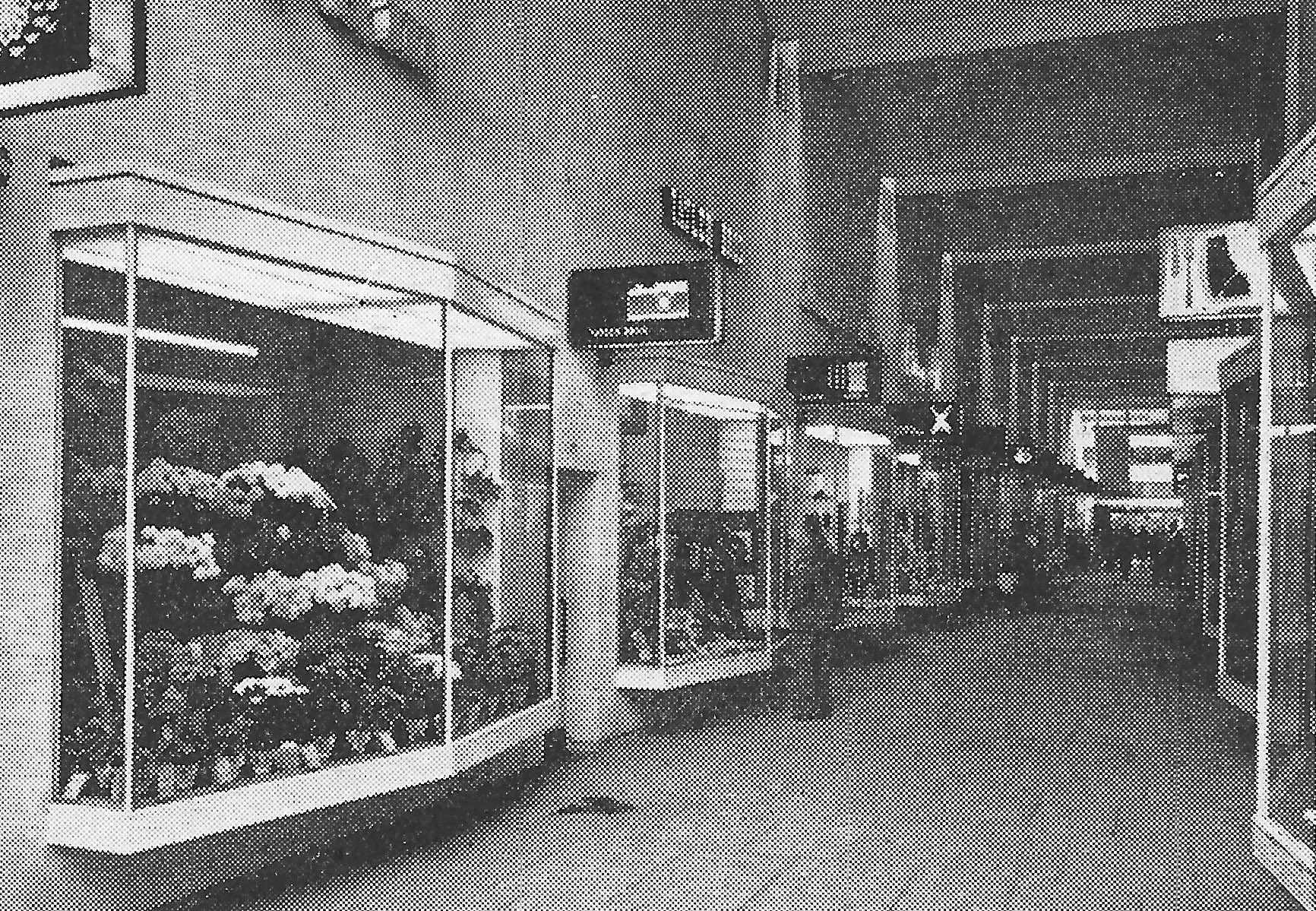
Fig. 220 Coventry. The shopping arcade. 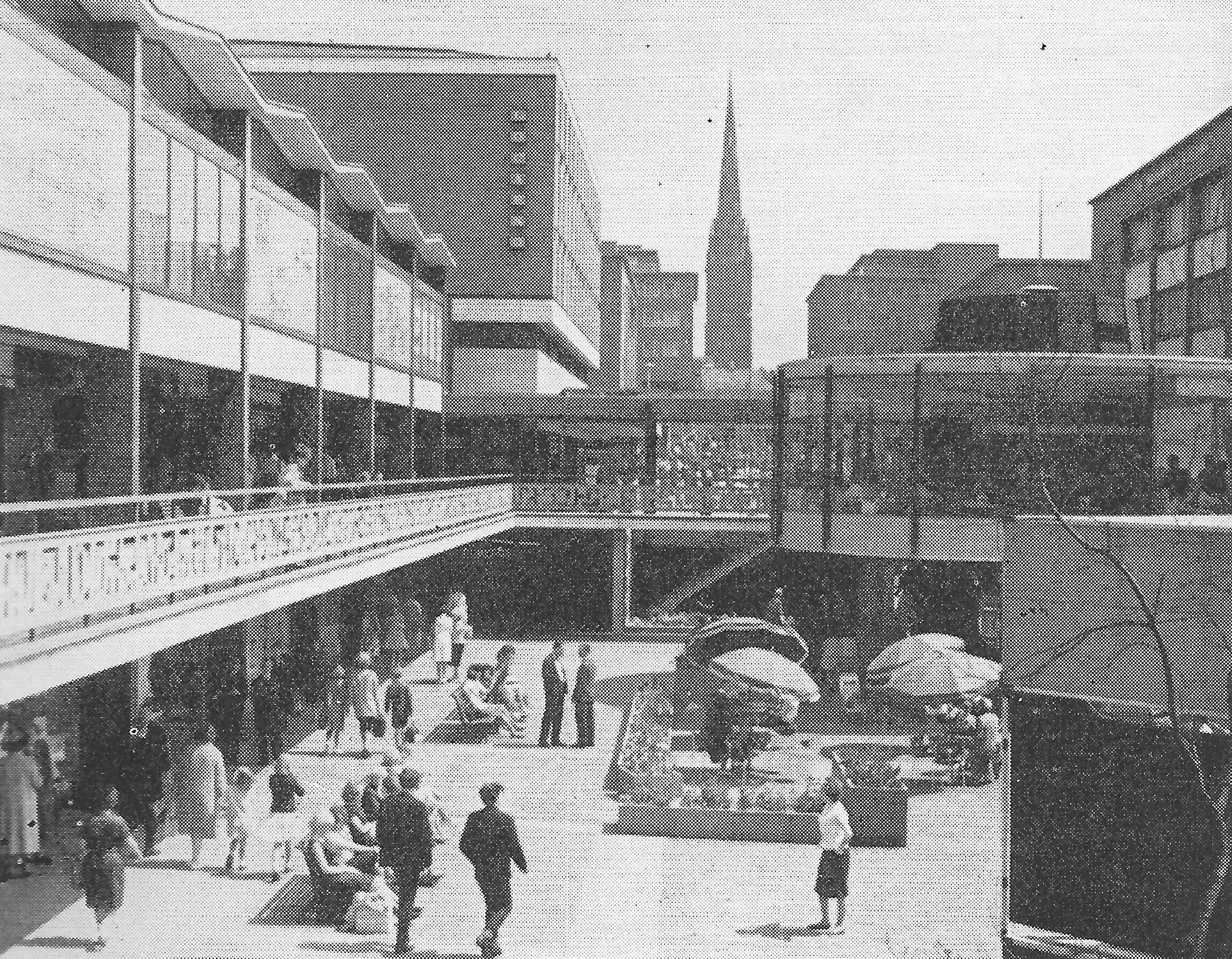
Fig. 221 The upper and lower shopping precincts at Coventry. This is one of the most interesting reconstructions in Europe, designed not only for motor traffic but as a place ‘…where it would be a pleasure just to wander about and sit around’. 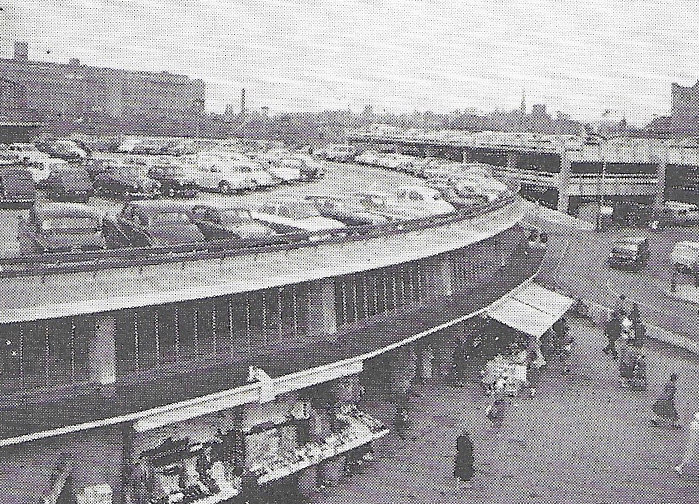
Fig. 222 Coventry. The system of roof-top parking. There is interconnection from building to building.
Coventry
392However, to return to the bombed city reconstructions, we do not wish to imply that all the work has been abortive, so much as to suggest that could the work be started again it is most likely that it would take a different form. We think this would even apply to the one case we propose to discuss in more detail-Coventry-generally regarded as one of the most interesting reconstructions in Europe.
393The outstanding feature of the rebuilding of the centre of Coventry is the very extensive shopping precinet reserved entirely for pedestrians. It is much more than an ordinary street merely closed to vehicles. It is rather a whole series of connected open spaces with fronting shops, full of variety and interest. Part of this precinct has shops at an upper level served by a balcony. Part is covered over, and elsewhere there is a good deal of protection from the weather without shutting it out altogether. There are flowers, trees, pools and sculpture. It was conceived like this from the start, a definite attempt to make a place where it would be a pleasure just to wander about and sit around. Yet it did not come easily by its present form and scale. The precinct as originally planned was quite small in area, with surface car parks and goods access to the rear, and much of the shopping was to be along conventional roads. Then gradually the magnitude of the potential growth of motor traffic was realised, opportunities were seized (not without opposition) to change the plan and extend the precinct, and the insuffciency of space for parking was overcome by bringing the roof tops into use, with bridges from building to building. It is a tribute to the initial plan that it was flexible in this way, and it is perhaps the quite considerable clement of expediency in the design that gives it the vitality it possesses. Nor does the process of adjustment seem to be at an end even yet, for the volume of traffic gyrating round Broadgate Square is manifestly unsatisfactory, wasteful of the potential public amenities of the square, and it cuts off the precinct from the Cathedral. We understand that a large extension of the precinct is now proposed.
394The eventual manner in which this design will function for traffic purposes is shown in Figure 223. It will be seen that there is a rigid enclosure by an inner ring road into which run the nine major radial roads of the city. Inside this ring, and enclosing the central precinct, is an innet circulatory road' which will carry the central area bus service, and distribute commercial vehicles to the service entrances of buildings. Car parking is to be contrived almost entirely at roof-top level or in multi-storey garages, with a quite elaborate linkage at roof level to give access from one car park to another. Access to the parking system is to be primarily from the inner ring road, not from the inner circulatory road, As might be expected with an inner ring road so obviously aligned for use for cross-town journeys, the expected traffic volumes are considerable and will necessitate a high-powered road. It is expected that it will mainly take the form of an elevated road on the northern and eastern sides, and will incorporate a depressed section on the southern side. Despite these and the fact that the present plans indicate the simplest possible forms of intersection, it is difficult not to have misgivings about the circumferential severance of the city centre which will result.
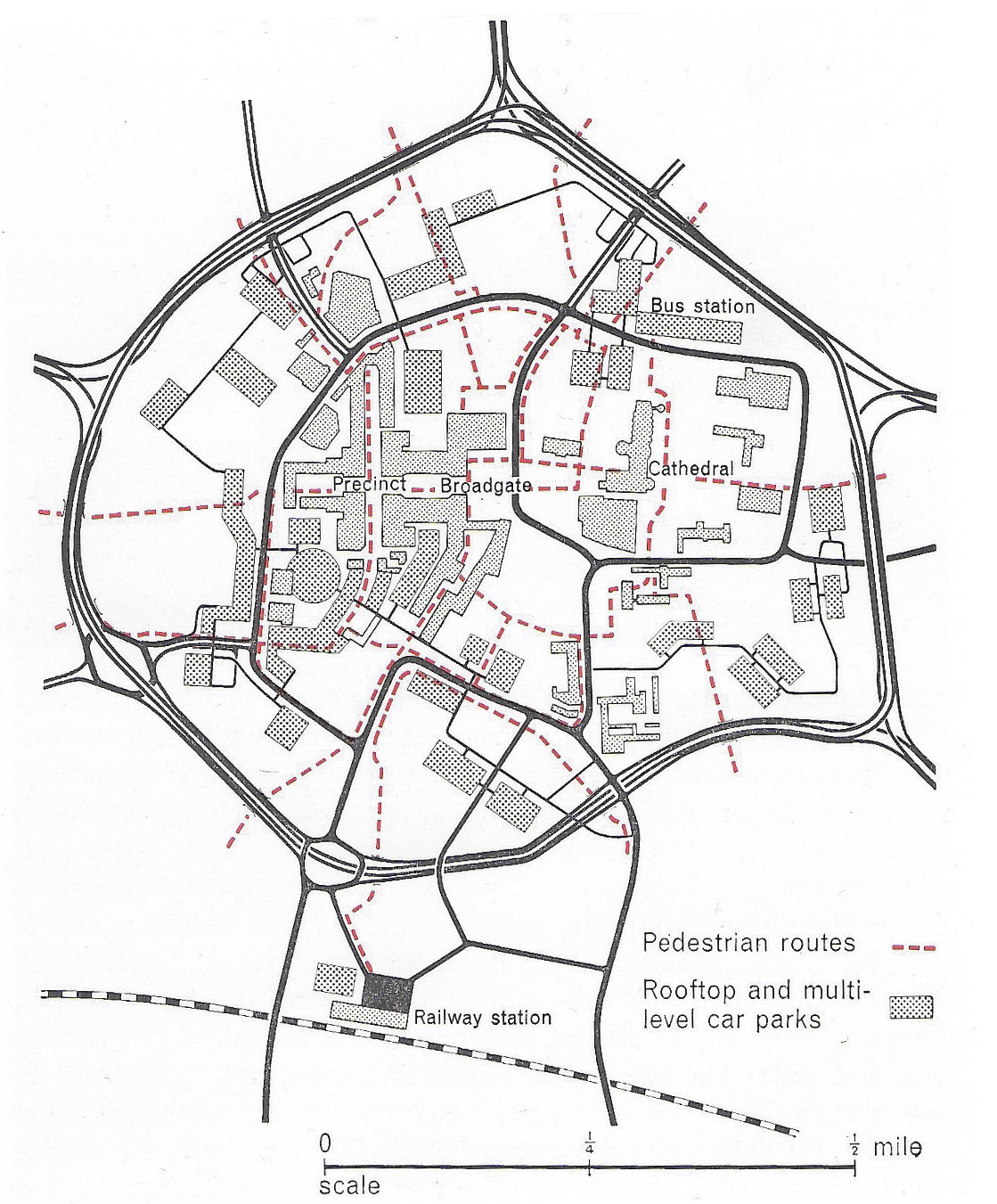
We have asked ourselves two main questions about Coventry: how far does this central reconstruction enable the motor vehicle to be exploited ? and is it a prototype for the ‘motorized city’? It is not easy to get at the answer to the first question, but it may be noted that an eventual number of 7,500 parking spaces is to be provided for the centre. This is in relation to a population of 360,000, and may be compared with the figure of 20,100 spaces for a population of 524,000 which we estimated could be provided at Leeds with the scheme for the intermediate network. At a rough estimate this would accommodate 40% of the potential number of work journeys by car to the centre. A direct comparison cannot be taken very far, but it does suggest that in Coventry a smaller proportion of people are likely to be able to travel to the central area by individual car. Indeed the wording of the Coventry report puts it quite clearly ‘…the majority of people will still travel into the city by public transport…’. It is important that adequate public transport facilities to and from and within the central area should be maintained. A reduced frequency or standard of service would cause a far higher proportion of people to travel into the city by car, thus adding to the traffic problems of the central area in its developed form'. Our own rough interpretation of the position is that, given the broad design of the central area as contemplated, it is unlikely that more than about 30% of the personal journeys made to the central area for all purposes can be envisaged as being made by individual private car. It is very unlikely, of course, that the position will ever arise when people will seek to make 100% of the journeys by private car, but even so it can be seen that in Coventry, in spite of a massive and virtually complete reconstruction of the central area, certainly to a more advanced form than in any other city in Britain, the result is still very far from being ‘fully motorized’ in the sense of the freedom to use private cars. It will not be a matter of hoping for the maintenance of public transport, as of the absolute necessity to keep it going. This for a city of 360,000 population.
396As to the question of Coventry being a prototype, it can be said at once that it undoubtedly is, as regards the standard of the environmental concept on which it is based. Whether it is a prototype in the design sense is open to question. We are inclined to think, for all the originality of the design, that were it to be started afresh it would in all probability take a quite different form, and that this would permit a higher level of motor car usage.