Chapter 4: Some lessons from current practice
The Development Plans: 397–401
Society, it would seem, will need to realise that it cannot go on investing ad libitum in motor vehicles without concurrently investing equivalent sums in the physical accommodation for the vehicles…
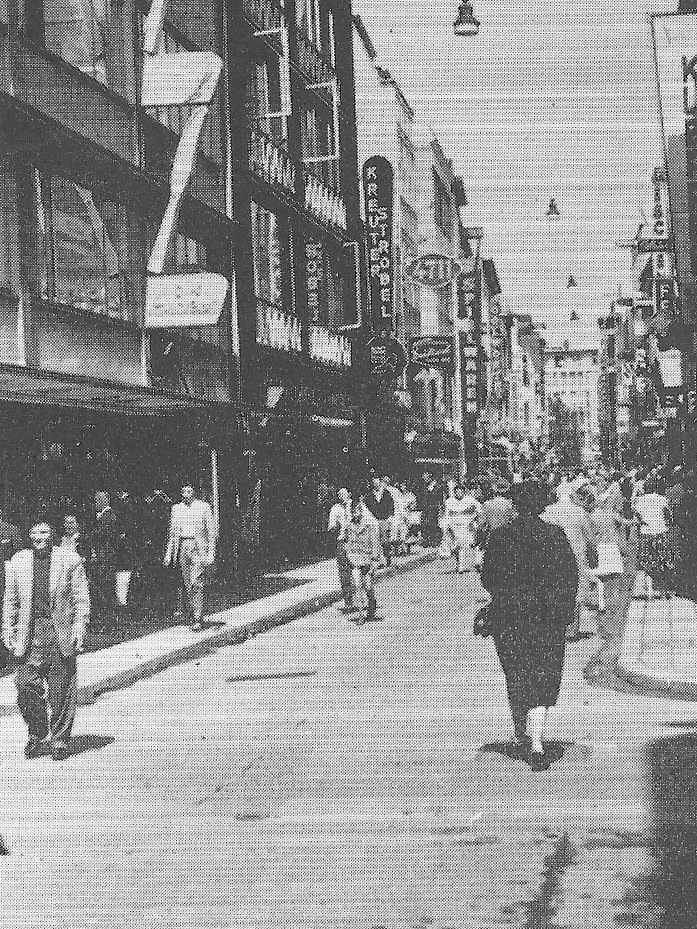
Fig. 224 Cologne. The Hohestrasse in its reconstructed form. One of the main shopping streets of the city, it is closed to vehicles during normal hours. 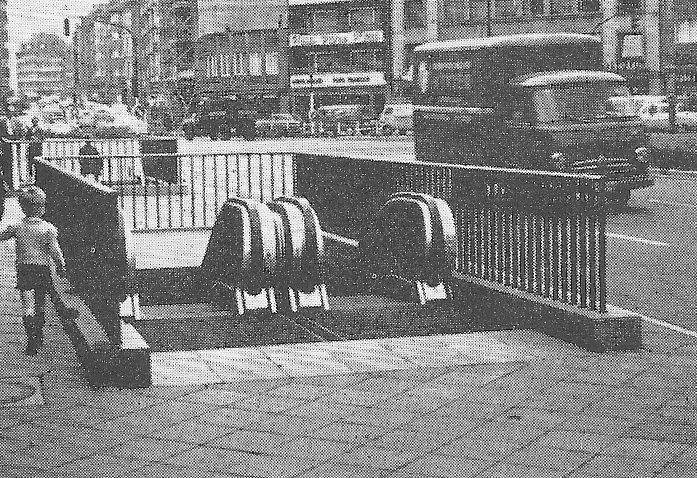
Fig. 225 An interesting feature of German reconstruction is the use of escalators in the open air. This example from Dusseldorf gives access to a pedestrian subway under a busy road.
The Development Plans
397Under the Town and Country Planning Act 1947 (as now merged into the 1962 Act) all local planning authorities (that is to say county councils and county borough councils) are required to prepare development plans for their areas. These plans show the intended uses of all land for a period of twenty years ahead, and the programme for realisation. The plans have to be reviewed, and if necessary revised, every five years. When the plans have been approved by the Minister of Housing and Local Government there is a statutory obligation on the planning authority to control all new development in accordance with the provisions of the plan. This machinery provides a complete system both for making a plan and securing, albeit in a somewhat negative way, its implementation.
398As far as towns are concerned, the development plans take the form of ‘Town Maps’ drawn to a scale of 6 inches to a mile, which are sufficient to show the land uses in some detail together with the locations of car parks and existing and proposed roads. There are in addition certain other procedures whereby larger scale plans are prepared for areas where redevelopment is imminent.
399Taking the development plans for towns as a whole, we think it is fair to say that very few of them deal adequately with future problems of trafic and transport. If it were otherwise, of course, this Report would not have been needed. The main defect is the absence of a general philosophy securely based on sound objectives and scales of values. All too little quantitative anatusis has been carried out, with the result that many proposals are based on intuition. In many instances the supposed needs of through traffic have been given priority over the needs of town traffic, with the result that proposals abound which, if executed, would be fatally damaging to local environments. There has been virtually no consideration of the problems of transport as a whole—railways, for example, have been consistently regarded as undertakings quit removed from the sphere of statutory town planning. Finally there has been the blighting effect of a sense of hopelessness as far as capital investment has been concerned, There is no incentive to produce creative plans if no hope can ever be seen of their implementation.
400It is, in fact, when the programming of the proposals in the development plans is examined and compared with the expected rate of increase in the number of vehicles, that the real shock comes. There is no semblance of agreement between the two. Proposals that could be amply justified to deal with even today's traffic are frequently relegated to the long distant future. This is a fault in social priorities, and not the fault of those who make the plans. Society, it would seem, will need to realise that it cannot go on investing ad libitum in motor vehicles without concurrently investing equivalent sums in the physical accommodation for the vehicles.
401In spite of these difficulties, the planning system based on development plans is clearly an instrument of enormous social value, indeed indispensable. Our suggestion is that it should be strengthened, by ensuring that traffic and transport are fully integrated into the planning process.