Chapter 4: Some lessons from current practice
Basingstoke: 384–387
The price to be paid for this concentration of traffic onto a few purpose-designed roads is that the roads themselves are of high standards with elaborate intersections, and of course very expensive.
Basingstoke
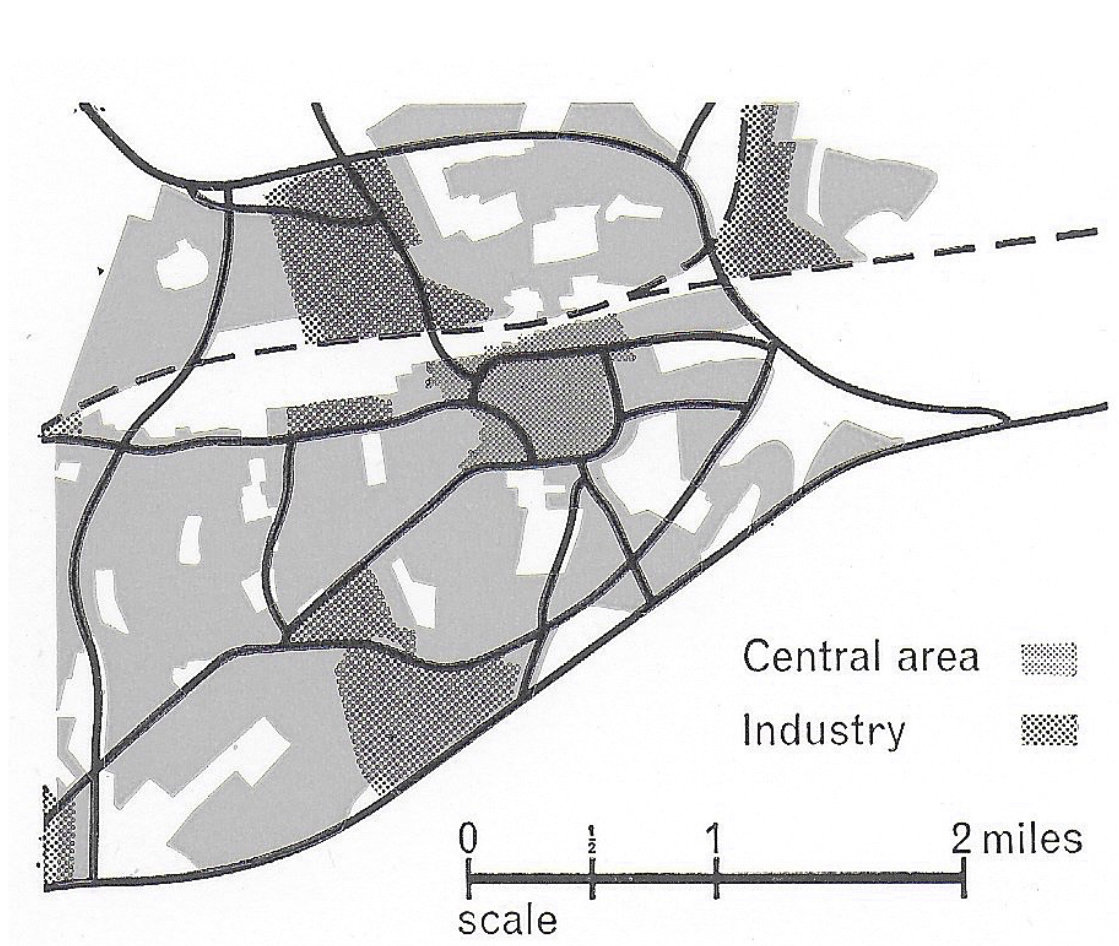
384Seeking to learn more about the problem of existing towns, we examined the proposals drawn up for the expansion of Basingstoke. The proposition here is to expand the town from its present population of 26,000 to 75,000, to receive population from London. In addition there is a dependent rural population of about 30,000 to be catered for. In the evaluation of the design a conventional plan for inner and outer ring roads superimposed on the existing radial system was first examined. This was discarded when it was realised that it would require the extremely expensive widening of the radial roads, all of which have frontage property with direct access (Figure 215). Nor was it possible and it is a common difficulty with all such proposals to find an alignment for the inner ring road which did not involve serious severance and destruction of property. A new approach was then tried based on a careful study of traffic movements, and on a delineation of the various parts of the town possessing an ‘environmental value’ to help decide the location of the new network roads, and without any preconceived ideas about inner rings, or indeed any geometrical patterns.
The agreed plan is shown in Figure 216. It will be seen once again that a giant Radburn design has emerged, consisting of a grouping of environmental areas served by a comparatively simple primary distribution network which canalises all the longer journeys, draining the main traffic flows away from the habitable areas. The approach to the town centre is strictly disciplined and is confined virtually to one transverse road. The price to be paid for this concentration of traffic onto a few purpose-designed roads is that the roads themselves are of high standards with elaborate intersections, and of course very expensive.
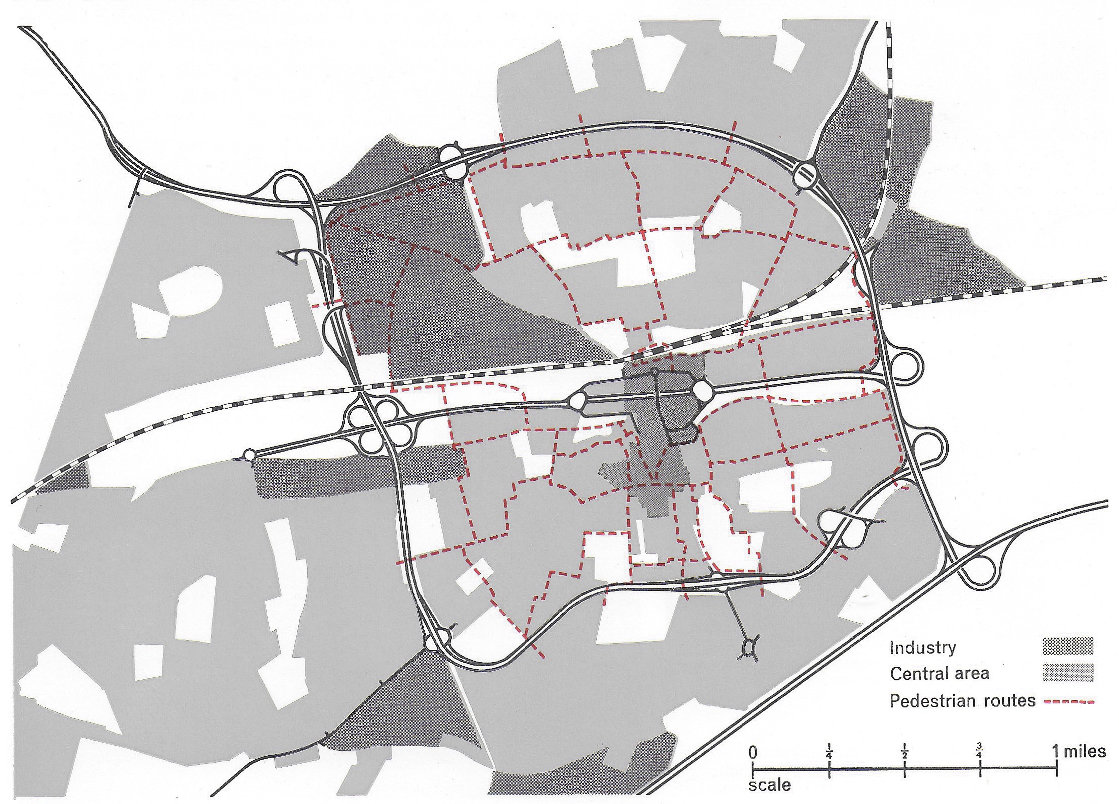
The proposals for the central area provide for a virtually new centre north of the existing one. To provide the necessary space at reasonable cost it was found necessary to build it on a deck above the natural valley. Underneath this, two levels of car parking will be provided, with access from the town centre approach road. There will be 6,000 central area parking spaces. An ingenious system of construction is proposed for the deck: it will be hollow in order to accommodate ducts and services, and strong enough to enable the buildings upon it to be freely laid out largely independent of the layout for traffic below. On the deck a complete, intimate, pedestrian area will be created. As at Hook and Cumbernauld the advantages of two-level planning for both accessibility and environment are strikingly demonstrated.
387This, of course, is not strictly a case of a design for an existing town, since the great increase of the population does introduce an element of ‘new town’ opportunity. Nevertheless all the central part of the town is closely developed already, and the case can be taken to show that for a town of 75,000 persons, it is probably possible to provide for most of the motor usage people are likely to require so long as works of a considerable magnitude are undertaken.