Chapter 4: Some lessons from current practice
Hook: 381–383
The road plan was calculated on the basis of 1-5 cars per family, which is considerably higher than the figure used at Cumbernauld, and somewhat higher than the figure at present obtaining in California
Hook
381In order to establish what level of car ownership can reasonably be designed for, we next examined the London County Council’s project for a new town at Hook, a scheme which was worked out in some detail, though never built. This, if not a clear derivative of Cumbernauld thinking, was certainly inspired by the same desire for a plan based on a proper understanding of traffic movement. The plan once again is a huge Radburn layout, with an independent pedestrian system gravitating direct to the decked town centre (Figure 214). The planned population in this case was 100,000, and the basic assumption was that ‘private cars will be the main means of personal transport…’. The road plan was calculated on the basis of 1-5 cars per family, which is considerably higher than the figure used at Cumbernauld, and somewhat higher than the figure at present obtaining in California. So this design purports to show that it is possible to provide for a very high level of vehicle ownership and usage in a town of 100,000 population, provided it is purpose-designed from the start. But the whole form of the town is so startlingly different, that there must be a large element of doubt whether an existing town of the same size could be successfully adapted to give the same standards of motor usage. Certainly the cost and disturbance would be very great,
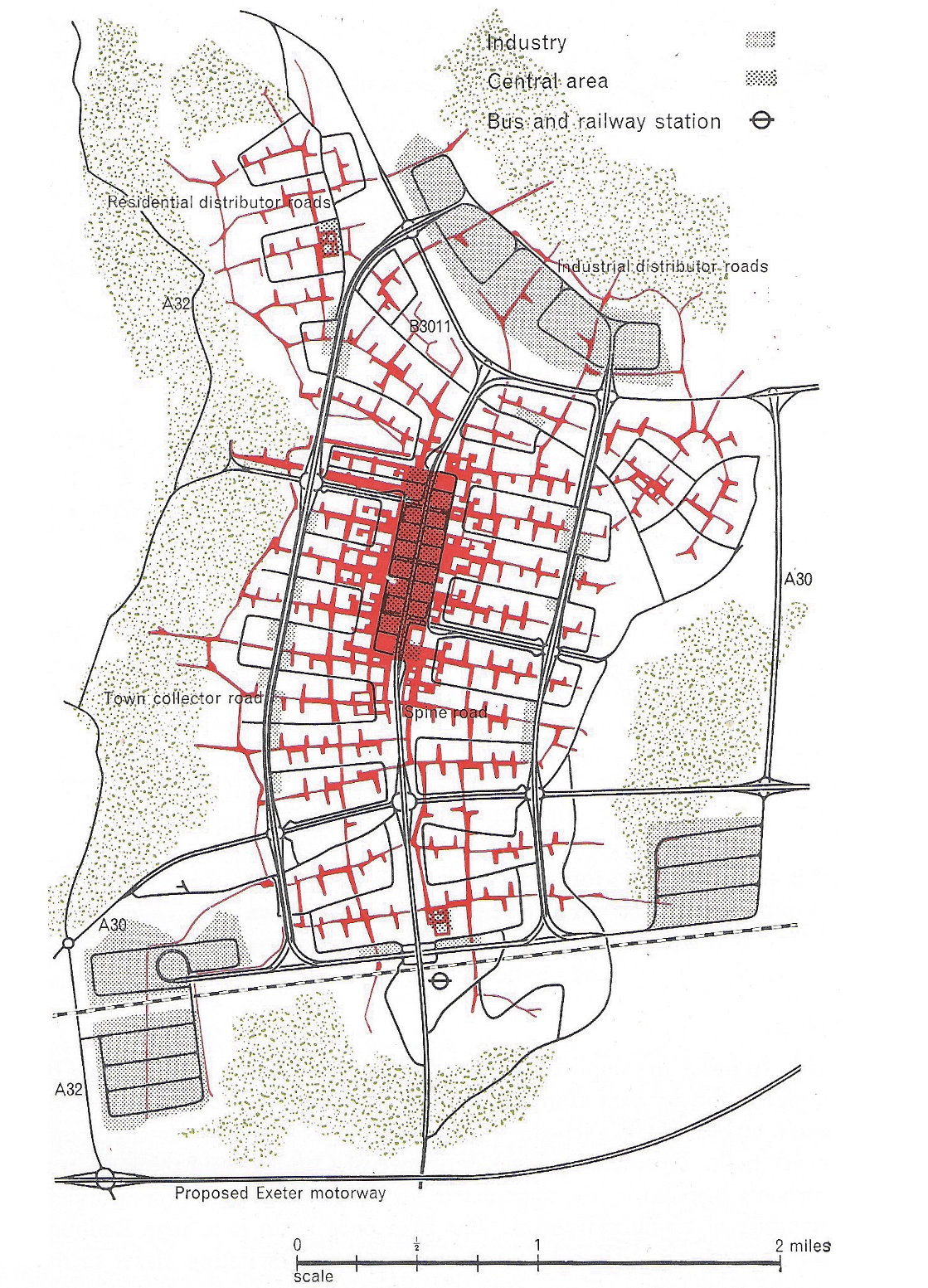
It should be noted, to avoid misunderstanding, that even in the case of Hook, in conditions of full car ownership and usage, it was considered that a bus service would still be required. This was for the benefit of the not inconsiderable proportion of families who would not have cars, and for young, old and disabled persons, and for the convenience of other members of one-car families when one member has the car. The Report on Hook did not make it clear whether a bus service in these conditions would be economic. We doubt whether it could be so, and it is possible that some other kind of transport service, such as the cheap taxis that operate in parts of the United Stares, would be a more attractive proposition.
The Hook scheme provides a good demonstration of the working of the ‘law’ referred to in Chapter II (para. 116). High environmental standards, with great convenience and pleasantness of scene for pedestrians, were decided upon as initial objectives. Consequently, in order to secure a high level of accessibility, complex architectural and engineering forms are required at high cost.