Chapter 4: Some lessons from current practice
‘Second generation’ New Towns-Cumbernauld: 376–380
The vehicular approach to the centre is circuitous, usually necessitating a journey out and round and then in along the road under the centre. The pedestrians’ approach, via a completely separate system of footways, is direct
‘Second generation’ New Towns–Cumbernauld
376We turned from the ‘first generation’ New Towns with some doubts of their capacity to withstand the onslaught of full car ownership to look at the first of the ‘second generation’—Cumbernauld, in Scotland, a town expressly designed 'to master the motor car'. This is a town with a planned population of 70,000 which is being built to assist the relief of overcrowding in Glasgow. The great interest of the case is that it was the first example in this country of a serious, systematic attempt to elucidate the relationship between activities and traffic.
377The preliminary studies started with a tentative plan which was then, as it were, tested to destruction. This plan was conventional in character, with radials and outer and inner ring roads, in principle not unlike the plans of the earlier New Towns. When this plan was tested, however, by methods somewhat similar to those employed in our own study of Newbury, it was found that staggeringly high volumes of traffic would build up on certain parts of the network, particularly on the inner ring road. It is not necessary to follow through all the steps of the analysis; it is sufficient to say that when all adjustments and counter adjustments had been made, the plan that emerged was strikingly different from all the plans of the earlier New Towns. The road network is shown in Figure 213. It is generally of a simpler pattern than in the earlier New Towns, and in relation to population there is a lower mileage of main road. But the principle of concentrating as much vehicular traffic as possible on roads specially designed for free flow and safety and giving very little choice of route, does mean that the network consists of high-powered roads of near motorway standards with elaborate intersections. This is exactly what we found in the study of Newbury.
378The plan for the central area is a particularly interesting feature of Cumbernauld. This is of linear form, built on a deck above the approach road. The idea of an inner ring road encircling the central area has completely vanished. The shops and business premises are to be built on the deck with a number of dwellings on the top again. Thus cars, buses and service vehicles are brought in underneath the shops but in very close proximity thereto, and complete separation of vehicles and pedestrians is obtained. Such an arrangement of course necessitates the use of escalators. It is as though the pedestrian centre at Stevenage had been jacked up 20 ft. and the surrounding car parks and ring road pulled in underneath. Ground space is saved, and the bleak parking and service areas are drawn in out of sight.
379Yet Cumbernauld is by no means designed for motorised movement and nothing else. In addition to its good accessibility the design seeks to establish an equally good environment. A deliberate feature has been a general concentration of development as compared with the earlier New Towns, partly with the object of facilitating pedestrian movement, especially to the centre. In Figure 213 the main pedestrian ways are indicated. It will be seen that the whole town is, in a sense, a gigantic Radburn layout. The vehicular approach to the centre is circuitous, usually necessitating a journey out and round and then in along the road under the centre. The pedestrians’ approach, via a completely separate system of footways, is direct.
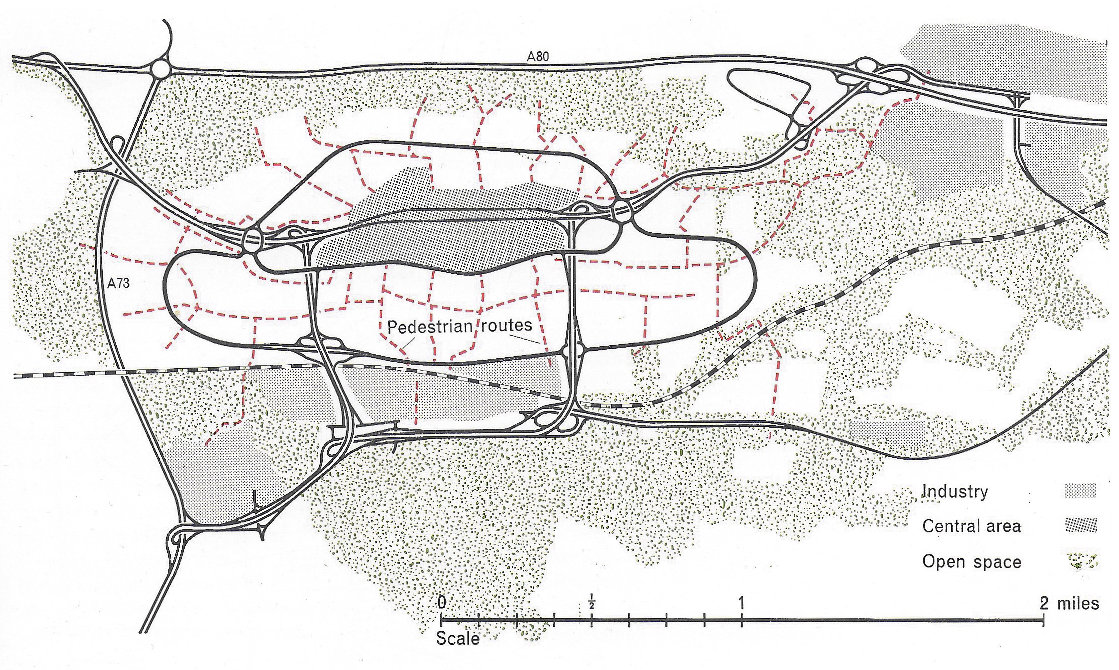
The Cumbernauld plan is based on a car ownership level, in the fully developed town, of one car per family. Up to that level it may be assumed to give all the freedom of car usage people are likely to want. But there now seems every prospect of the level rising a good deal higher than this. So the plan itself does not establish that a town of 70,000 people could be designed to cope with full car ownership, but our assessment is that with certain alterations in layout it would be possible. But it has to be noted that this is a design for a new town, with all the advantages inherent in designing on a clear site. To remodel an existing town of this size for the full potential ownership and usage of cars would be much more difficult and costly, but we think physically it could be done.