Chapter 4: Some lessons from current practice
Venice: 412–417
Venice proves in fact to be an extraordinarily interesting example of a network and environmental area system, rendered crystal clear because the distributory network consists of canals instead of roads
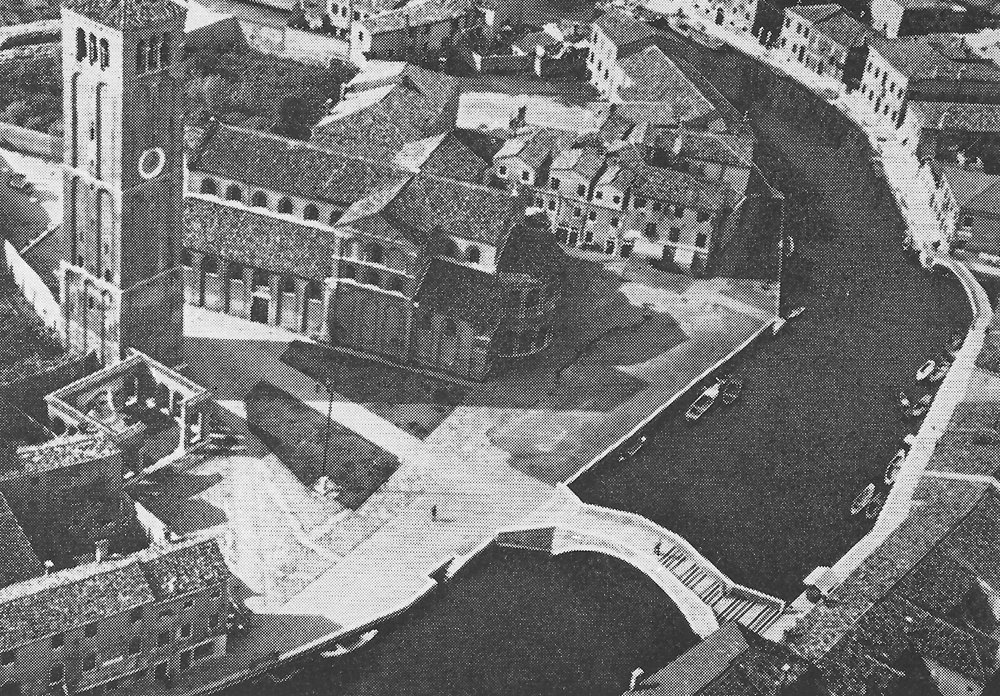
Fig. 235 Venetian townscape. There is complete separation between vehicular and pedestrian circulations.
Venice
412It may appear to be taking liberties with the title of this chapter to include Venice as an example of current practice. But it is a working city and one of the very few in the world which, on the face of it, manages without the motor vehicle. So we decided to examine it to see what lessons could be learned.
413Venice is a city of about 140,000 people on a group of islands in the Laguna Veneta. The city is connected by a causeway carrying both road and rail to the mainland at Maestre where there is a sizeable industrialised hinterland, where many residents of Venice find employment. So it is not absolutely true to say that Venice is a self-contained community not dependent on motor vehicles. Supplies, visitors and commuters arrive at and leave the city by road and rail. Nevertheless both road and rail are strictly confined to terminals at the north western fringe of the islands, and all the distribution to and from these terminals, and all the busy life of the city (bigger than Huddersfield, and with one of the largest tourist trades in the world), is carried on without wheeled motor vehicles. It is certainly not done without motor vehicles, because a great deal of the movement and transport is now contrived by motor boats on the canals.
414Venice proves in fact to be an extraordinarily interesting example of a network and environmental area system, rendered crystal clear because the distributory network consists of canals instead of roads. The primary distributor is the Grand Canal—a major highway, two miles long and varying in width from 120 to 230 feet. The shallow depth of water and the restricted headroom below the bridges place a limitation on the type of vehicle, and speeds are officially restricted to just over 5 m.p.h. Water bus services operate on the Grand Canal. The ample width and the low volume and speed of traffic make it possible to mix the traffic functions, and the distributor is used both for movement and for direct access to some premises. The Grand Canal gives access to a further 28 miles of waterways which can be described as district distributors (usable by water buses) dividing the city into some 14 areas, and a more tortuous network of narrow local distributors.
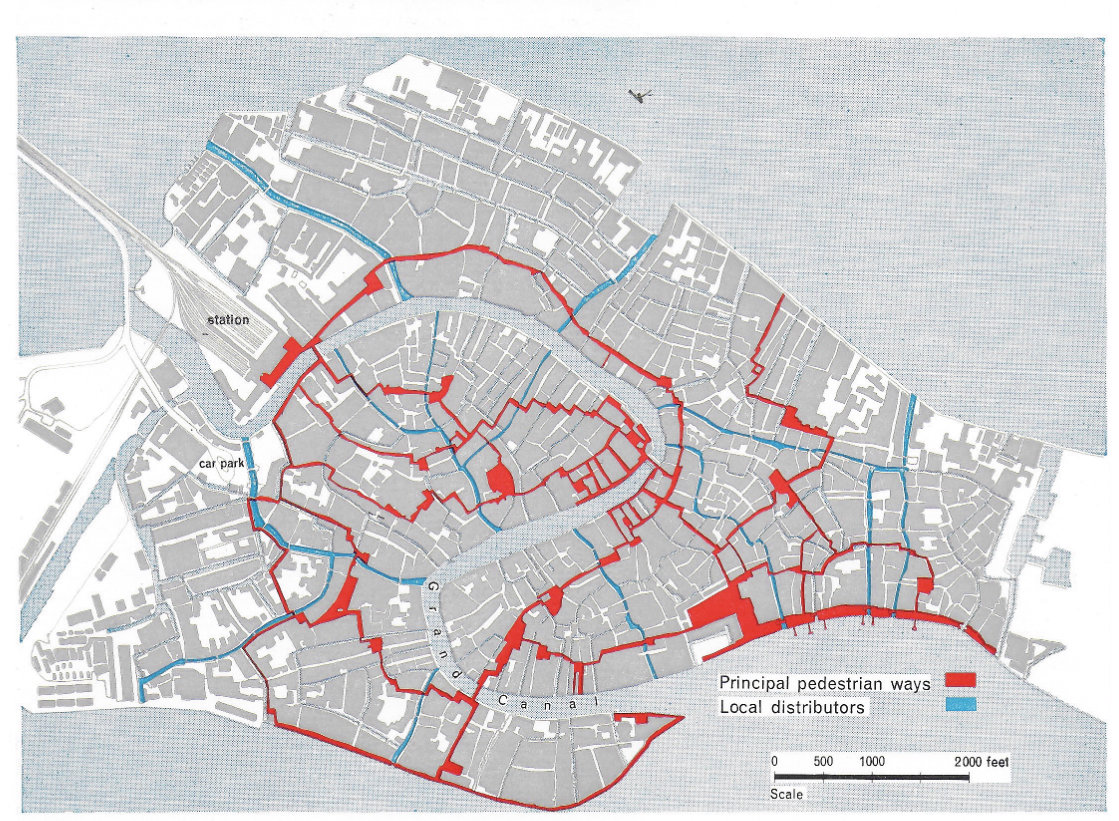
Thus there is a clear system and hierarchy of distributors for vehicular traffic. In addition there is an entirely separate and extremely complex, continuously linked, system of pedestrian ways and alleys with a total length of about 90 miles. These are punctuated at intervals by piazzas around which each section of the city clusters. The piazzas are still the chief places of local assembly, worship, market and shopping. On this pathway network a splendid urban pedestrian environment is created. Continuity of the network is achieved, of course, only by an immense number of 'pedestrian overpasses' or, to put it simply, bridges over the canals. There are, however, only three bridges over the Grand Canal, and this makes for considerable inconvenience of pedestrian movement. Although the canals are remarkably penetrative throughout the clusters of buildings, enabling goods to be brought very close to destinations, there is also considerable use of the footways for final distribution by hand and by trolleys.
416The communication system in Venice provides almost complete safety for pedestrians. There is no major nuisance from noise, but exhaust fumes from boat engines can be unpleasant. There is no visual intrusion of vehicles in the pedestrian environment, and even on the distributors themselves the boats, unlike wheeled motor vehicles, seem to enhance rather than depreciate the scene. As to accessibility, most of the piazzas (or shopping centres) are served by water bus routes within distances comparable to those usually planned in this country, but for most people the walking distance from their homes to bus routes is greater than would be tolerated in a conventional layout served by motor vehicles. There must also be considerable difficulties in servicing buildings, furniture removals, burials, fire services, refuse removal and postal deliveries. Nevertheless the place undoubtedly functions, and reasonably well at that, without the strains and tensions set up by motor vehicles operating in conventional streets. But the picture drawn above is undoubtedly also influenced by the fact that private ownership of vehicles is low: conditions where every household made daily use of a mechanically propelled vehicle, even though it were a boat, would obviously be less desirable.
417The important lesson of Venice is not that a large city can manage without wheeled motor vehicles—we are not suggesting the conversion of streets to canals—but that an interdependent system of vehicular and pedestrian ways can be contrived with complete physical separation between the two—so complete that they do not even seem to belong to the same order—and that it works. It is interesting that it was basically a Venetian arrangement which emerged in our comprehensive redevelopment study of the Tottenham Court Road area.