Chapter 4: Some lessons from current practice
Los Angeles: 422–424
…this eventually manifested itself in a visible deterioration of the physical structure, as unprofitable buildings gave way to open parking lots when attempts were made to revive the attractiveness of the centre to the car-owning public
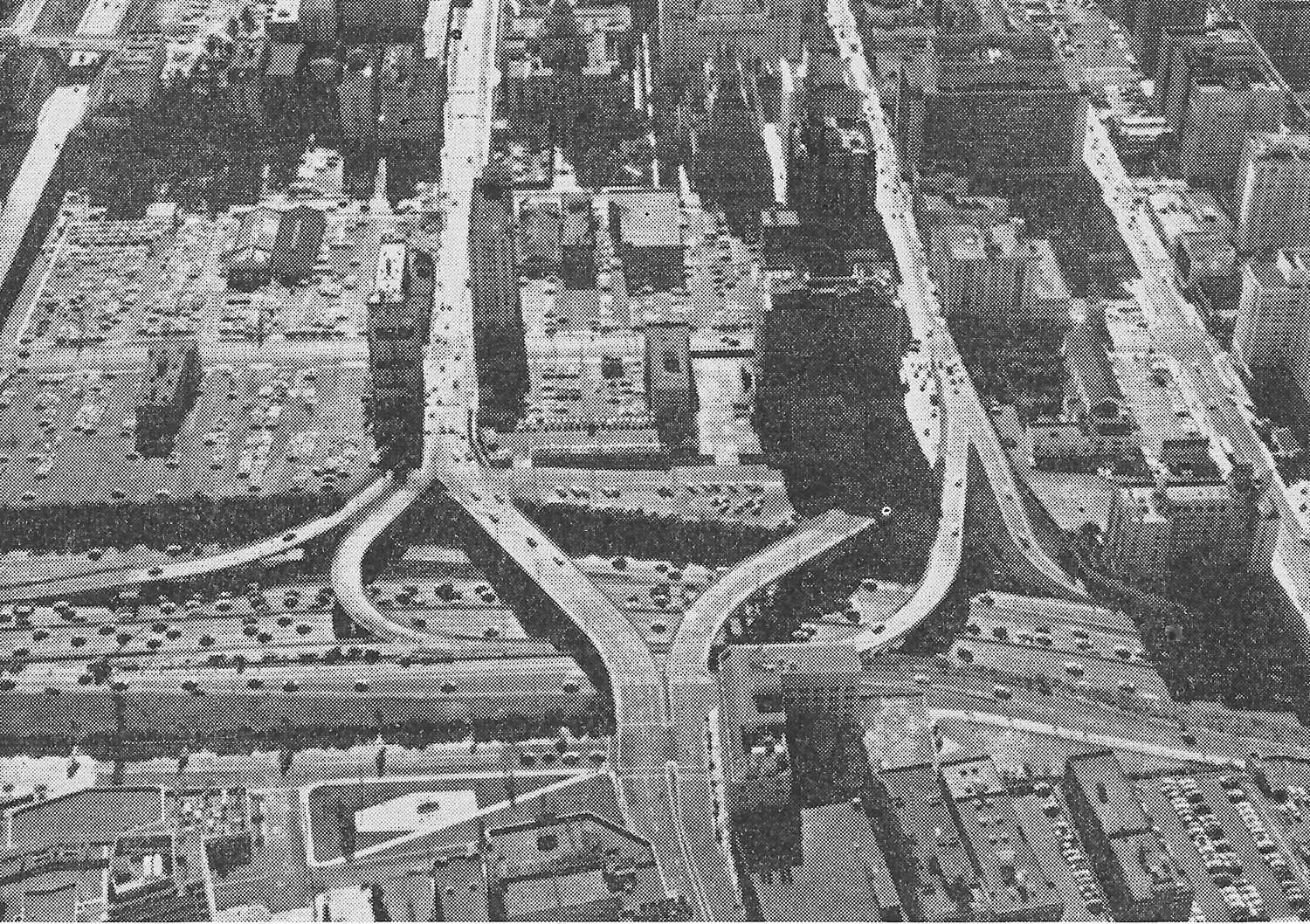
Fig. 238 Los Angeles. The Harbor Freeway skirting the downtown area. The disintegration of the downtown area into open parking lots is clearly visible.
Los Angeles
422Initially sprawl starts as a groping for more space for living and for movement and with the belief that, with cars, distance does not really matter—but in the end it produces ever-worsening problems of transportation. The sequence of events is clearly illustrated by Los Angeles which deserves special mention for its claim to have the highest car ownership rate in the world. This enormous conglomeration of development appears to have started as a wide scatter of individual settlements centred on the larger town of Los Angeles itself. In the early days there was an efficient electrified railway linking the settlements. The great expansion of population by immigration then started, and with the motor vehicle then on the scene it produced, as might be expected, a low density spread of development reaching outwards from the old centres. This spread is now roughly 80 miles long and 50 miles wide, but with immigration running at 600 persons per day, it is still expanding.
423The electric railway did not long survive the competition of the car, and its end was assisted by the proliferation of level-crossings as development spread out. But eventually the motor vehicle itself began to run into difficulties. The conventional roads along which expansion had taken place became progressively more inadequate for a highly mobile community, and parking problems and congestion in the downtown centre of Los Angeles itself became acute. A ‘natural’ remedy then began to assert itself. The presence of big suburban populations fostered the growth of suburban shopping and business centres that became highly competitive with the downtown centre on account of the better parking and traffic facilities. The downtown centre suffered considerable loss of business in consequence, and this eventually manifested itself in a visible deterioration of the physical structure, as unprofitable buildings gave way to open parking lots when attempts were made to revive the attractiveness of the centre to the car-owning public. At the same time, however, the construction of an elaborate network of quite new roads—freeways as they are called—was commenced with the object of facilitating travel over the length and breadth of the sprawl. This network is now about one-third finished (eventually it will provide a 4-mile grid over the whole area) and already it has greatly facilitated travel, particularly to the downtown area which is enclosed by four tangential roads. Much of the network has had to be built through standing property, and the expense and disturbance have been enormous. That is the position at the moment. It remains to be seen how far the downtown centre will revive itself, and what further development the freeways will themselves stimulate.
424Los Angeles prides itself upon being the most motor-minded city on earth. Should it be regarded therefore as a prototype? This is a difficult question to answer. There are places in the Californian sprawl where the workers in the splendid new factories of the 'second industrial revolution' (as the electronic age has been called) live within easy reach of the sea, in houses built to standards far beyond anything we can yet aspire to. There are air-conditioned shopping centres accessible by car, schools, colleges and universities, and a wide range of recreations. If these conditions could be offered to people living in the hard-pressed circumstances of many of our industrial cities, it is difficult to believe they would not grasp them as little short of Utopia. Yet a big doubt remains, for it is impossible to look at Los Angeles as a whole without concluding that had it been the product of deliberate planning, with full powers of land use control, it would have developed quite differently. Almost certainly it would have been made more compact; and one main reason for this, very pertinent to the problem under discussion, is that dispersal taken beyond a certain point complicates the transport situation by positively generating the need for vehicular movement. What Los Angeles does demonstrate is that a big sprawl can function, after a fashion, on the basis of motor transport alone, provided the density of development is not excessive, provided there is only a 'weak' central area permitting the avoidance of the massive traffic flows that a 'strong' centre generates, and provided highway engineering works of the most formidable nature are undertaken. But there is nothing to suggest that we would gain by spreading our own cities out, or still further spreading the conurbations, in order to reproduce the conditions of Los Angeles. All the American experience of sprawl suggests that in our small country we would do well to have no more of it.