Chapter 1: the working context
Increase in the numbers of vehicles: 44–47
…a problem which has not previously been given any prominence but which yearly assumes greater importance, namely the sheer capacity of urban areas to accommodate motor traffic without serious deterioration of the environment
Increase in the numbers of vehicles
44The growth in the number of private cars would seem to depend primarily upon the growth of incomes, but it is also dependent upon the price of cars, insurance rates, taxation levels, and upon such factors as changes in shopping habits, the availability of garage space, the amount of frustration due to congestion, the existence of other cheap and convenient forms of transport, and the future patterns of recreation. It will also depend on the growing familiarity with and acceptance of the advantages of having a motor car. The increase in the number of goods and commercial vehicles will depend upon the usefulness of this form of transport to the firms involved, and to the coming into existence of new firms, new processes, and new or expanding markets, The future number of public transport vehicles depends largely upon the extent to which the public does or does not switch its travelling habits to private cars. Underlying both the growth in numbers and the usage of vehicles is a problem which has not previously been given any prominence but which yearly assumes greater importance, namely the sheer capacity of urban areas to accommodate motor traffic without serious deterioration of the environment.
45
With so many variables and imponderables, the assessment of the future number of vehicles can proceed only by the projection of past trends and consideration of the recent experience of the United States.* On this basis, there is a prospect (in Great Britain) of 18 million vehicles (including 12 million cars) by 1970, of 27 million vehicles (including 19 million cars) by 1980, and perhaps of 40 million vehicles (including 30 million cars) by 2010. There are at present (early 1963) some 10½ million vehicles, so what is involved is a doubling of numbers within I0 years, and nearly a trebling within 20 years. It is important to note that nearly half the total increase is expected within the first ten years (Figure 38).
*See, for example, 'Forecasts of Future Numbers of Vehicle in Great Britain', by J. C. Tanner of the Road Research Laboratory, Department of Scientific and Industrial Research, published in Roads and Road Construction September 1962.
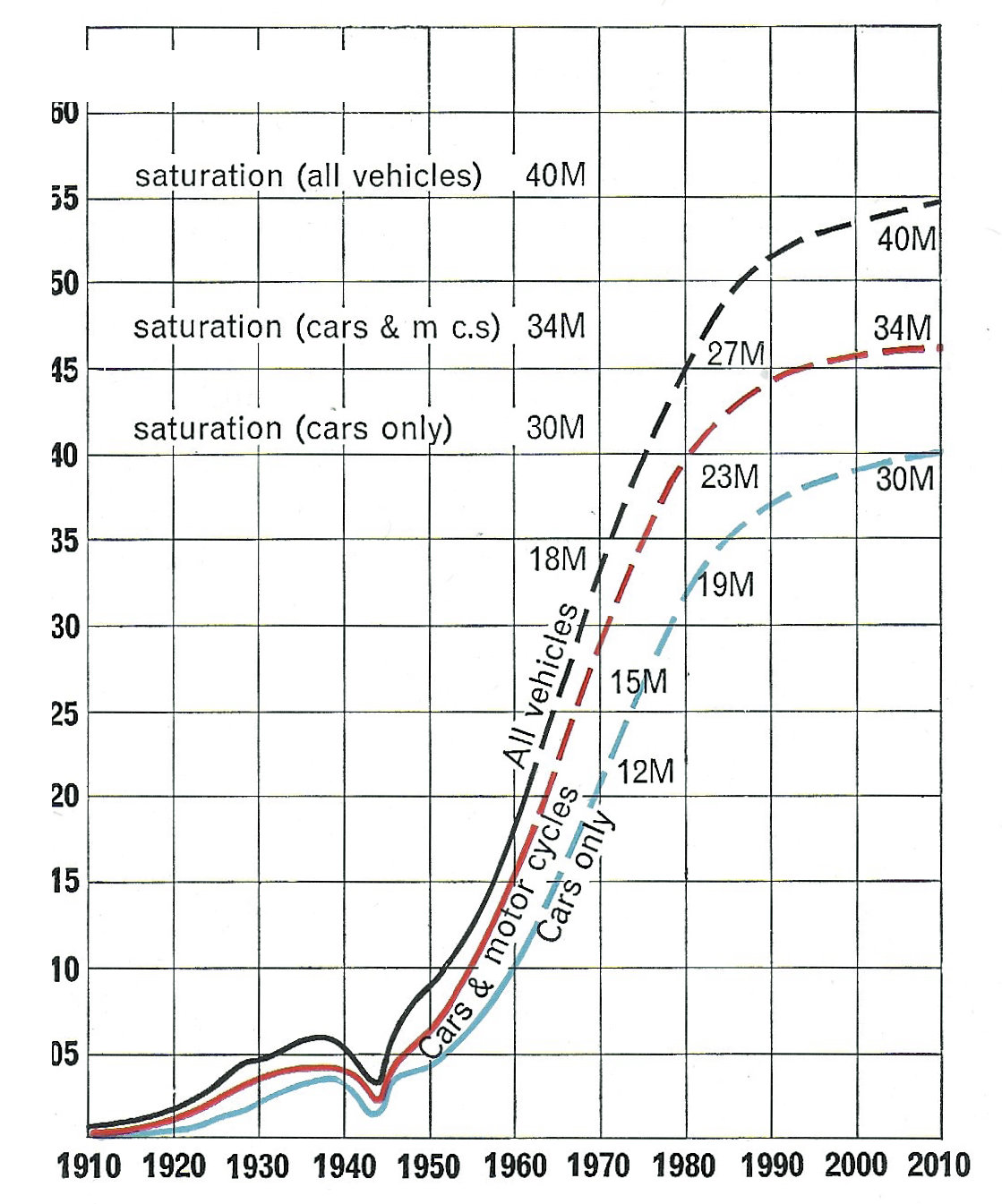
The figures given above take account of the estimated increase of the national population to some 74 millions by the year 2010† The significance of this particular date (or thereabouts) is that it is likely to witness the saturation point, or the stabilising of the ratio of numbers of vehicles to population. In other words, most of the people who want cars will by that time have secured them. The total number of vehicles will still continue to increase if the population increases, but not at the rate that can be expected in the next twenty years.
† This estimate is based on the projection for a 40-year period contained in the December 1962 Quarterly Return of the Registrar General for England and Wales, and the 20-year projection in the 1962 Annual Report of the Registrar General for Scotland.
47Various ratios are in use to express the relationship between vehicle numbers and population. We are inclined to think that the number of vehicles per 1000 population is the most expressive, though, in respect of cars, another meaningful (even if somewhat imprecise) ratio is the number of cars per family. Expressed in these terms, the figures given above for the year 2010 would be 540 vehicles per 1000 population, 405 cars per 1000 population, and 1.3 cars per family.