Chapter 3 – Part four: A central metropolitan block
Redevelopment in stages: 347–352
The whole redevelopment, however, is dependent, ultimately, upon the provision of the primary network whose construction and programming raises very difficult problems
Redevelopment in stages
347The scheme for ‘partial comprehensive’ redevelopment outlined here would be capable of being implemented in stages, and also of being executed by a number of developers or syndicates on a number of distinct sites. The whole redevelopment, however, is dependent, ultimately, upon the provision of the primary network whose construction and programming raises very difficult problems.
348The network in this scheme encroaches to some extent on the study area. It would be possible to undertake the redevelopment of the area in advance of the construction of the network, provided the traffic potential of the area is not allowed to build up beyond the capacity available in the existing approach roads. But obviously it would be short-sighted to delay the construction of the network too long, even if it could not be undertaken without the demolition of some propertics in the area. If the area were to be redeveloped concurrently with the construction of the network, then the properties could be replaced in the process. It is a feature of this scheme that even though the area is reduced in size by reason of the loss of land to the network, there is no displacement of accommodation. But if redevelopment were to be delayed then some of the uses would have to be replaced elsewhere.
349To illustrate a possible staging programme, we take the case where the area is being redeveloped concurrently with the road. But we empha-sise that events would not necessarily occur in this order in practice. A major road cutting across a standing urban area could not come into existence in time to be of any use, unless it were to be driven forward as one major project with resources concentrated upon it. But it is unlikely that all the adjoining sites affected by the road could be simultaneously redeveloped. Some might even precede it.
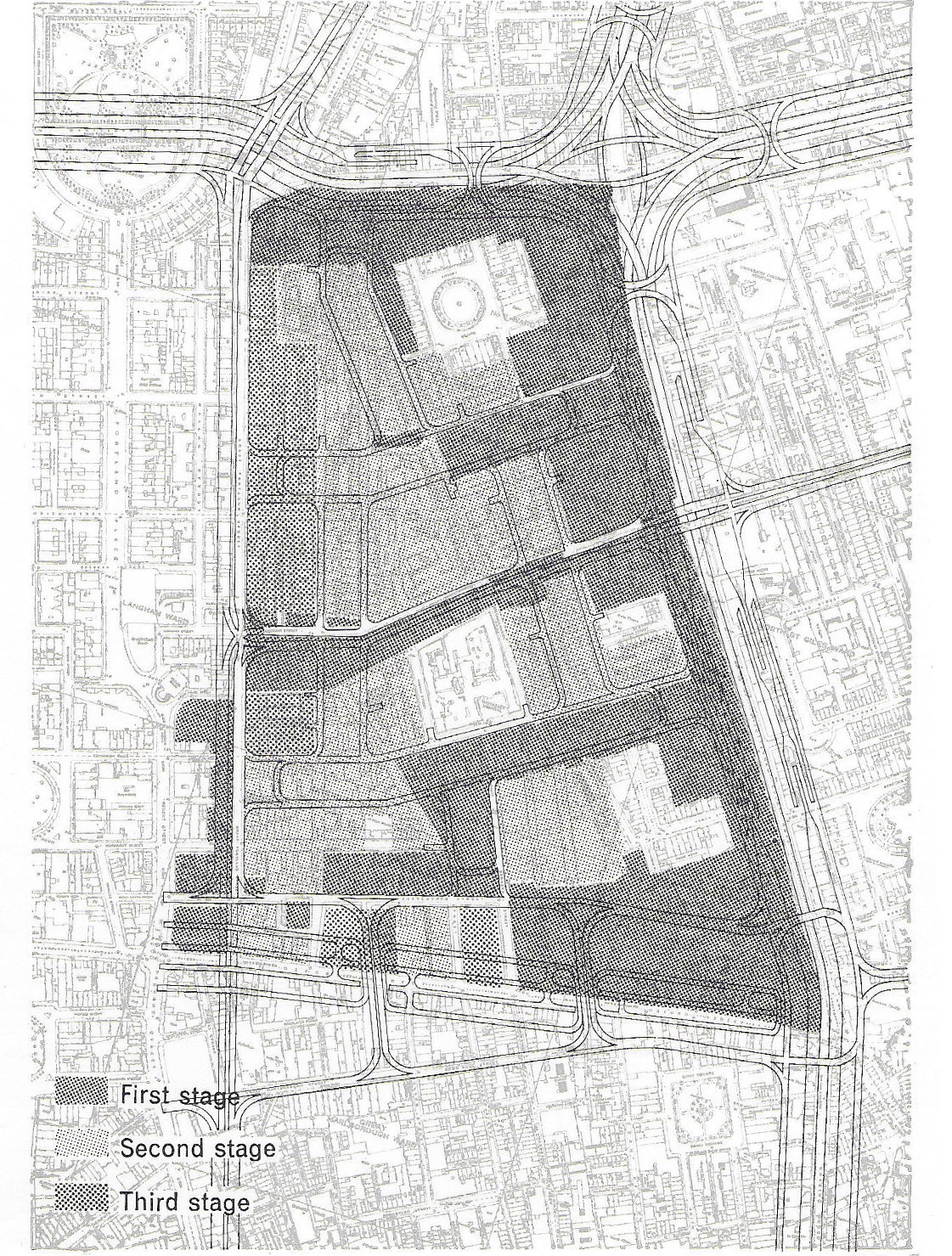
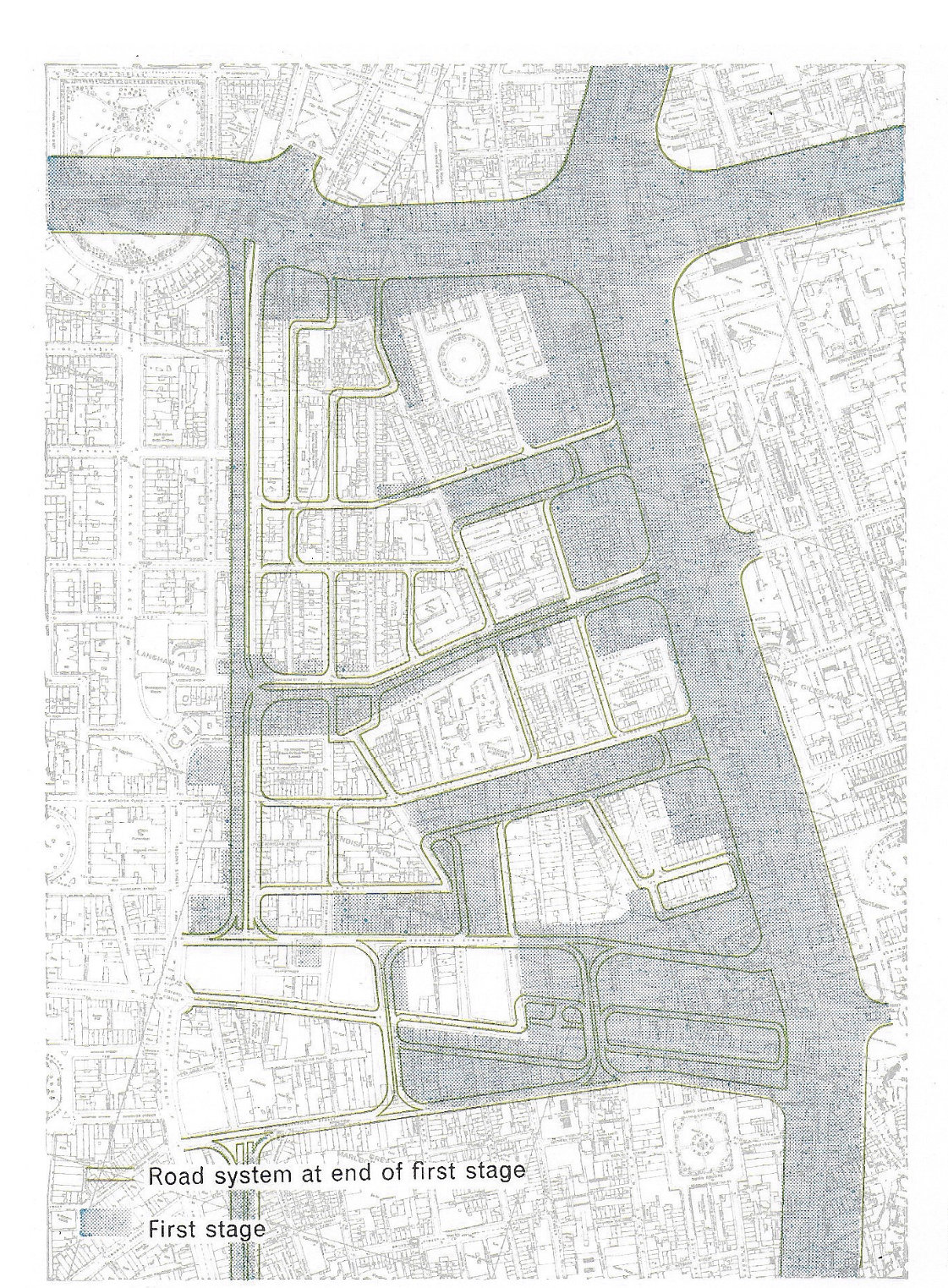
350As we have visualised it, the first stage would cover the construction of the primary network and the district distributors, together with the redevelopment of the war-damaged areas in the north-eastern part of the site, and the area of obsolete layout in the south-east. For these purposes 71 acres or 48% of the whole site would be needed, but about half of this amount would be taken up by the major distributors.
351To keep the possibility open of re-organising the area, it would be essential, all through the operation, to prevent the piecemeal rebuilding of small sites by private and public developers.
352The area dealt with in the second stage, covering 47 acres or 32% of the whole, derives from an examination of the age and condition of property, and from a study of the location of sites where applications for planning consent by individual developers have been made. The third stage covers 18 acres or 12% of the area, and covers the substantial properties in Great Portland Street and Oxford Street. Buildings and groups of buildings to be preserved account for 12 acres or 8% of the area. Figure 199 shows the three stages of redevelopment. Figure 200 shows how the road system would be arranged at the end of the first stage.