Chapter 3 – Part four: A central metropolitan block
Levels: 324–327
we felt that it is a better… to keep traffic at ground level, and to put the pedestrian environment above. This makes for much greater flexibility in the planning of the buildings.
Levels
324The density of development and the area needed for roads, parking and servicing were such that we could be reasonably sure that a multi-level plan would be required in order to gain the necessary space. We therefore gave some general consideration to this question to see what principles were involved.
325First we could see that there were advantages in keeping the primary motorway distributors at the lowest physical level of all the roads in the distributor hierarchy, and preferably below ground level in open cuttings. Experience abroad points to this being the most desirable on the grounds of reduction of severance, noise, and visual intrusion. In addition, if the primaries are generally at a lower level than the intersecting roads, then the design of interchanges is much facilitated, the primary does not have a switchback profile, and the slopes on the 'on' and 'off' ramps assist acceleration and deceleration.
326With regard to the relationship between the local distributors and the buildings themselves, the alternatives broadly are to keep pedestrians ‘down’ and vehicles ‘up’, or vice versa. The first has the advantage of freeing the whole ground area for pedestrian use, giving in effect an urban park with direct pedestrian access into the ground floors of buildings. Also, if vehicles are taken into buildings at some intermediate level in their height, it can be a useful arrangement where uses are divided vertically, e.g. traffic can serve shops below and offices above. Moreover, wonderful urban views can be obtained from high level access roads. There are, however, severe disadvantages in this arrangement which result from the rigid discipline that the high-level roads impose on the buildings, such as the amount of space taken up by access ramps, problems of structural design, and the cost. After considerable study of these problems we felt that it is a better principle in areas of high density to keep traffic at ground level, and to put the pedestrian environment above. This makes for much greater flexibility in the planning of the buildings.
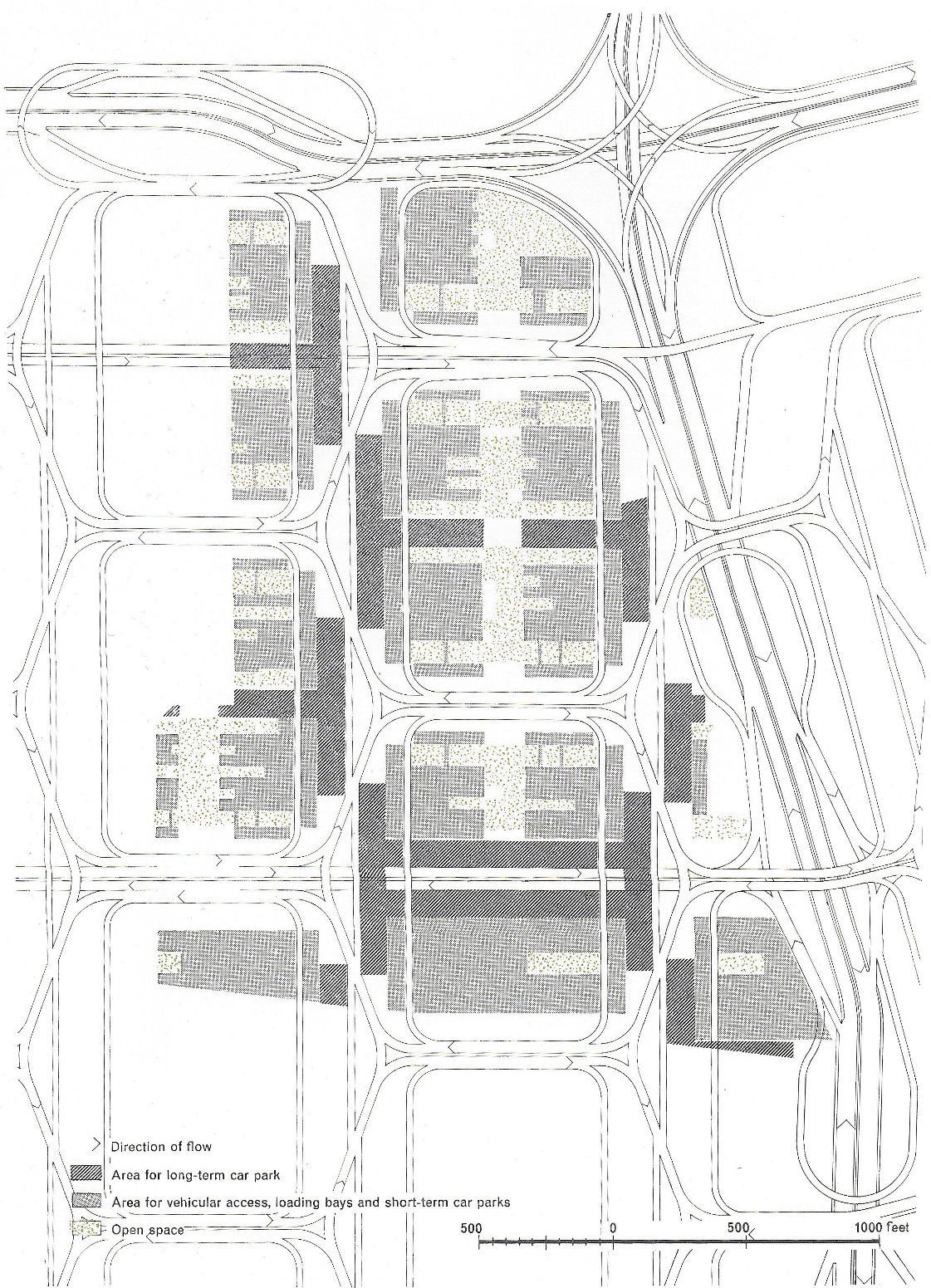
327Our conclusions on the question of levels, therefore, were to place the primary distributors at about 20 ft. below ground level, and to keep the hexagonal local distributors at ground level (Figure 180).