Chapter 3 – Part four: A central metropolitan block
Conclusion: 335
To bring such a design into being would need an almost revolutionary approach to questions of land ownership and development procedure
-
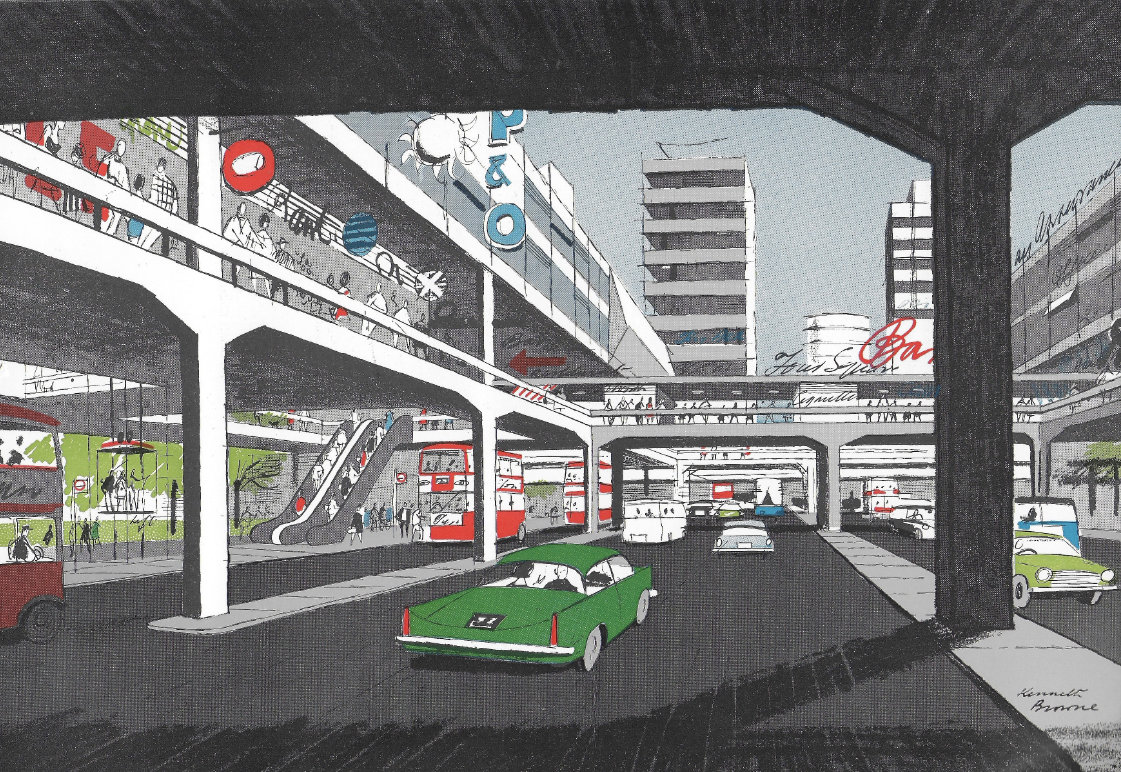
Fig. 186 An impression of the scheme for complete redevelopment, looking along one of the district distributors. Ground-level open space can be seen to the left. The drawing shows that in a multi-level reconstruction, the ‘driver's eye view’, far from being gloomy and subterranean, can be lively and interesting with plenty of opportunity for the driver to identify his whereabouts.
Conclusion
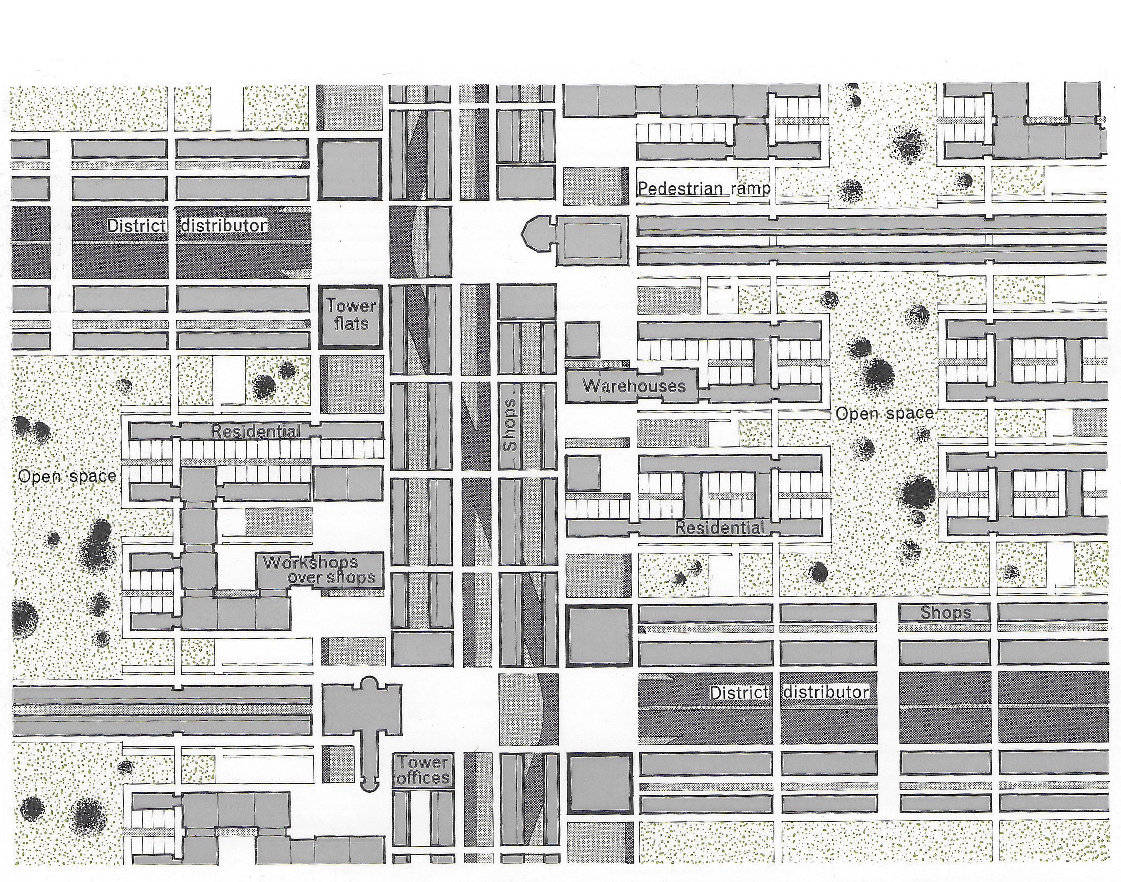
335We did not pursue the study any further than this. We had satisfied ourselves that even given complete and total redevelopment of a central high-density site, there would be a strict limit to the amount of traffic it could accommodate, dictated not so much by its own capacity as by the feasibility of providing a network to serve it and all the adjoining areas. Even so it was evident that to accommodate the maximum flows from the network (which satisfied all essential needs) would require a highly intricate multi-level design. To bring such a design into being would need an almost revolutionary approach to questions of land ownership and development procedure, but we are satisfied that there is nothing fantastic about the design itself. It illustrates vividly the point we have previously made that the awkward truth is that the motor vehicle is really demanding a radically new urban form. We think the design we have described gives an indication of the kind of form required, and shows that it would be possible to create a compact, varied, interesting, vital, intensely urban environment, yet with many of the advantages of motor traffic close at hand. But the design process requires a new outlook, a new synthesis of professional skills, for it is neither designing roads nor designing buildings, but designing the two together as a unified process. This is what we mean by traffic architecture.