Chapter III – Practical studies
The work journeys: 144
we had to establish the origins and destinations of all the work-journeys
The work journeys
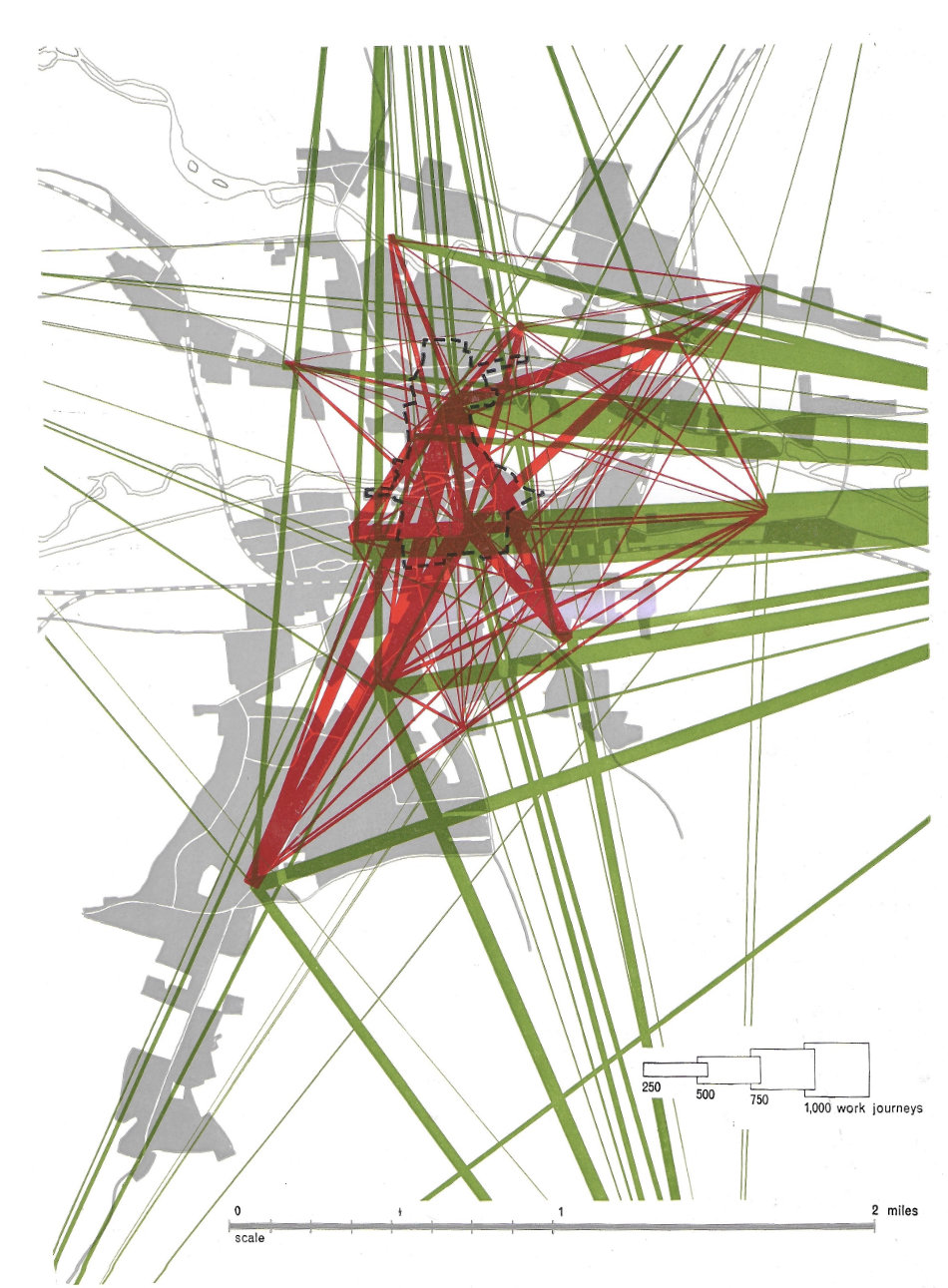
144Observation suggests that Newbury is no different from most other towns in that the dominating movements during the periods of the heaviest traffic flows are the journeys to and from work in the morning and evening, and so we concentrated our attention upon these in the first instance. Without making an elaborate survey (which at the least would have involved a sample survey of the population, requiring several thousand interviews), we had to establish the origins and destinations of all the work-journeys. To assist in this process we first divided the whole town and its dependent hinterland into a number of well defined sub-zones of residence and employment. With the help of statistics from the local planning authority, from the Ministries of Labour and National Insurance, and from the local rating assessments, we were able to establish the number of workers living in each residential zone, to classify them into income groups, and to make a series of assumptions as to where the people worked. This could not, of course, give completely accurate results, but we were satisfied that it gave us a fairly reliable indication of the main corridors of movement.
144These corridors of movement are illustrated in the desire line diagram shown in Figure 73. This diagram reveals the complex journey pattern that arises twice each working day at the present time.