Appendix 1: The environmental capacity of streets
West End Lane, Hampstead: 20–28
West End Lane, Hampstead
20We examined a 300 yards length of this road where it serves as a long-established local shopping centre in the middle of a high density residential area (Figure 3). There are about 60 shops with service access from the street and about 120 flats over the shops with pedestrian access either from the rear or from side streets. There are also a church, public house, library, petrol filling station, fire station and a public convenience situated on a traffic island. West End Green, a small open space with grass, seats and large trees, gives a pleasant character to the area. The carriageway varies in width from 22 ft. to 30 ft.
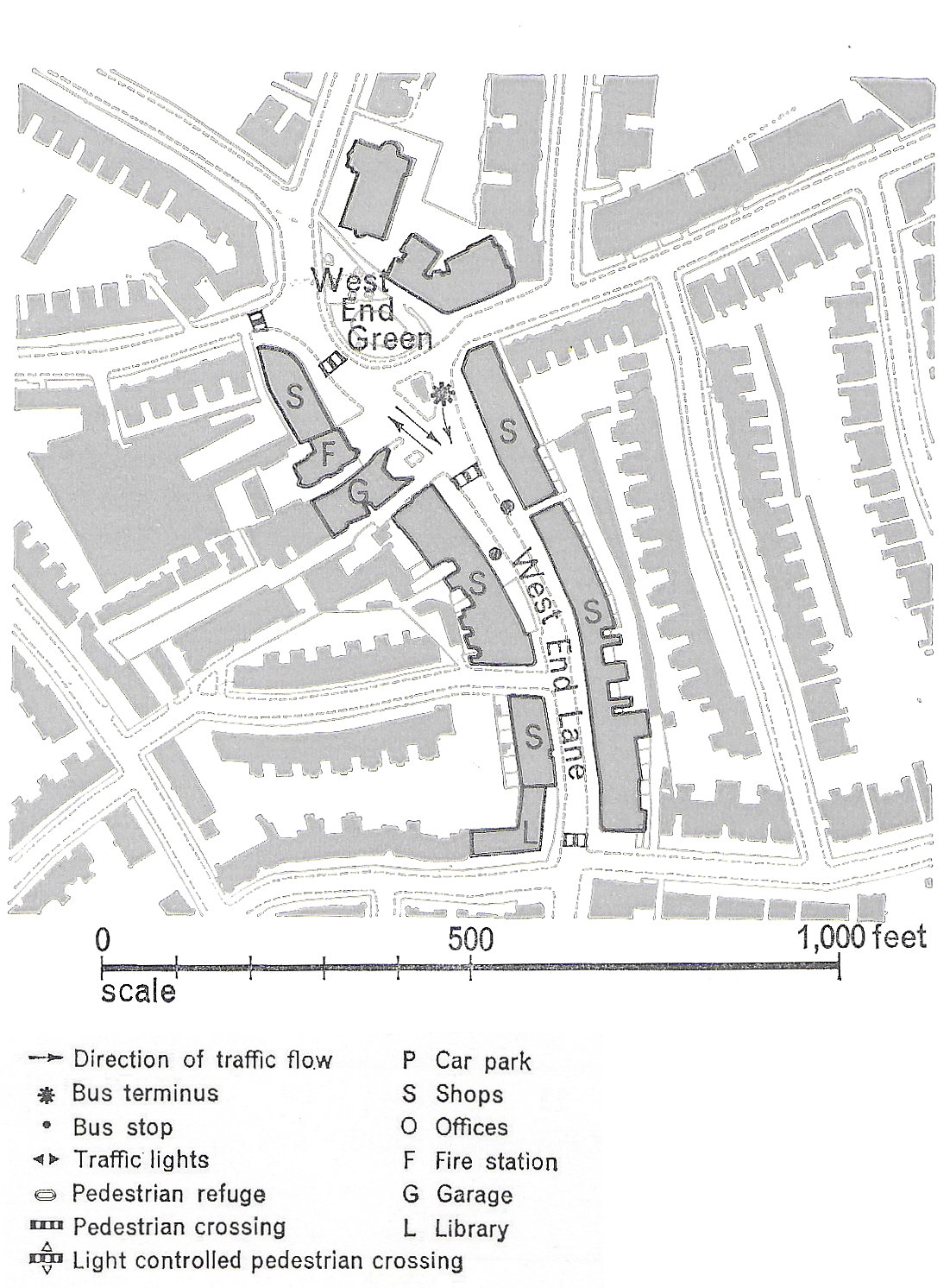
West End Lane is a Class II road. It provides a through route from Finchley Road and M1 (the London-Birmingham motorway) to the western part of the central area of London. In the length under consideration there are three terminating bus routes and one through route. In addition to the through traffic there is also, of course, all the local traffic associated with the shops, flats and other facilities. Traffic flows seemed not to vary a great deal with the time of the day, being between 1,000 v.p.h. and 1,200 v.p.h. in both directions at the morning peak period, mid morning on a weekday and on Saturday afternoons. The proportion of heavy vehicles varied from about 15% at mid-morning on a weekday to 8% on Saturday afternoons. Bus flows varied between 45 and 60 buses per hour in both directions.
22There are no parking restrictions in the length of street under consideration, with the result that for most of the day there are vehicles parked continuously along both sides of the road. The presence of these, combined with the through traffic make for congestion and difficulties of movement for much of the day.
23There is much pedestrian activity throughout the day. The combination, however, of large traffic flows and parked cars makes the street a difficult and dangerous one to cross. The pedestrian crossings are inconveniently placed at each end of the busiest shopping section, which invites people to cross elsewhere in places where, as they step out between parked cars, they cannot be seen by drivers. The Green, which could be a considerable amenity to the shopping area, is difficult of access because of the traffic, and even when it is reached the traffic is a continuous nuisance. The noise from the traffic is considerable, buses and heavy lorries being the worst offenders. The noise is aggravated by the slight gradient at the narrower part of the street to the south.
24Sound-level recordings were taken over 24 hours at the kerbside near the petrol filling station. The average hourly readings remained relatively constant at between 71 and 73 dBA* from 8 a.m. to 9 p.m., building up to a peak of 76 dBA between 6 and 7 p.m. Levels dropped to their lowest, i.e. 52 dBA, between 4 and 6 a.m. West End Lane is, of course, a residential as well as a shopping street. The Wilson Report suggests ‘as a tentative estimate‘ that for living rooms and bedrooms in dwellings in busy urban areas, a day-time level of 50 dBA and a night-time level of 35 dBA should not be exceeded for more than 10% of the time. Assuming a difference between external and internal noise readings for closed windows of 20 dBA, and assuming sound levels up to the fourth floor would be the same as at ground level, then, with windows shut, the 35 dBA level would be achieved only between the hours of 3 a.m. and 6 a.m.
* Decibels (dBA) are a convenient unit for the measurement of sound levels. They incorporate a frequency ‘weighting’ which compensates, to some extent, for the varying sensitivity of the human ear to sounds of different frequencies.
25We think there can be no doubt that in this street as it stands, with a volume of traffic of the order of 1,000 to 1,200 v.p.h. in both directions, the conditions are unacceptable, though it would be an exaggeration to say the street is unworkable as a shopping and civic centre.
26The basic difficulty is that West End Lane is used for two incompatible purposes—the passage of traffic and shopping. In this it is, unfortunately, typical of many thousands of shopping centres on radial and other main roads of towns throughout the country. If it is to continue to be used as a shopping street there is no doubt that it should have no vehicles in it at all. This would mean, however, the exclusion of not only the through traffic but of the local vehicles belonging to shoppers, firms, residents, and even of the buses. As far as through traffic is concerned there appears to be no possibility of a compromise. Either West End Lane must be adapted as a distributor road and the shopping centre removed, or the through traffic must be taken right out. To say which would be the better alternative, or where the through traffic should be put, would involve a network study of the kind demonstrated for Leeds in the preceding section but elaborated to the scale of London.
27Assuming that through traffic could be removed altogether from the street, we would still be inclined to say that further steps would be necessary to secure a satisfactory balance between accessibility and environment. The provision of rear service access to the shops would be extremely expensive, though it would enable the street itself to be used for pedestrians only. An alternative might be to convert this length of the street into a cul-de-sac or part of a loop system. We estimated that with either arrangement the peak hour flow at the entrance would vary between 70 v.p.h. and 100 v.p.h. according to whether buses were admitted or not. This would enable the carriage-way to be made narrower with waiting and loading bays at intervals. We considered that such an arrangement with the much reduced traffic flows would result in satisfactory environmental conditions, and would provide reasonable ease of access for the essential traffic using the street, the residential traffic and the terminating buses.
28A final point is that it is clear that a fire station and a petrol filling station are unsuitable uses in a street where the needs of pedestrians take precedence. A fire station, to fulfil its functions, needs to have quick access to a distributor road. Once West End Lane ceased to be such a road then it would no longer provide a suitable location for the fire station. The petrol filling station would, of course, attract traffic into the very place where it is not wanted. We think that petrol filling stations should be regarded as 'non-conforming' uses in all shopping streets.