Appendix 1: The environmental capacity of streets
Ben Jonson Road, Stepney: 29–32
Ben Jonson Road, Stepney
29This road, lying between Mile End Road and Commercial Road, acts as a local distributor. We studied a section where it also serves as local shopping centre, having been developed for this purpose soon after the war. The layout is shown in Figure 4.
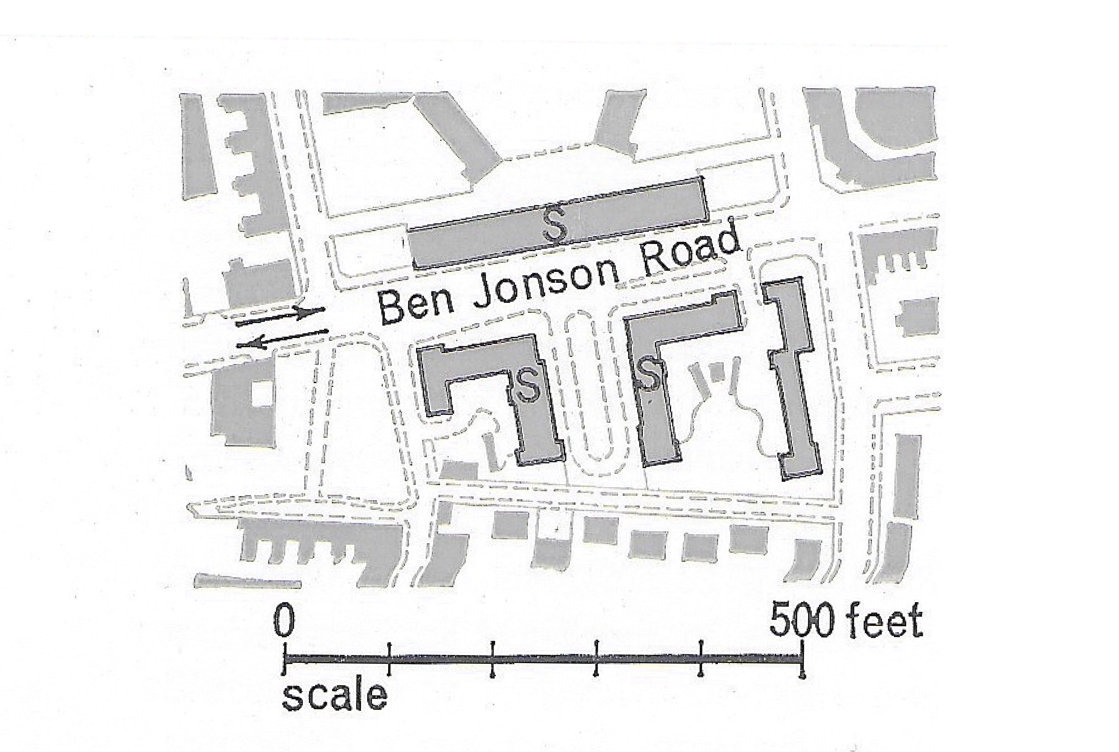
There are some 40 ‘shops with flats over’ in the centre, 14 of these being situated in the cul-de-sac. The carriageway has an average width of 24 ft. All the shops and flats are provided with service access to the rear, and there is in addition some front service space extending along a short section of the frontage on the south side of the road.
31We assessed the street for the mid-morning conditions, that is to say outside both the peak periods. The average traffic flow was about 380 p.c.u. per hour, of which 80% was through traffic, and 44% was comprised of commercial vehicles. Pedestrians crossed between the shops (excluding the cul-de-sac) at the rate of about 230 per hour. There are no pedestrian crossings. The bulk of the servicing of shops and flats was taking place ar the front of the buildings from the main carriageways, the purpose-provided service areas being apparently used only for refuse collection. Most of the vehicular space in the cul-de-sac appeared to be used for the garaging of residents’ cars and shopkeepers’ vans. There were no parking restrictions in Ben Jonson Road, and parked vehicles caused occasional obstruction and increased the dangers for pedestrians seeking to cross.
32We concluded that the speed of traffic (25-30 m.p.h.) was clearly incompatible with the requirements of the street either as a shopping centre of as a residential area, and that the volume of traffic was above a tolerable limit, though the conditions were not nearly as bad as in West End Lane. If the through traffic could be eliminated, the residual traffic amounting to about 75 p.c.u. per hour would be acceptable, and there could be several changes in the layout which would assist the centre to function more satisfactorily. We did not investigate an alternative line for the through traffic but merely drew the lesson that this was a case of comparatively new development where a much better result could have been obtained if only there had existed at the time a closer appreciation of the effects of traffic on shopping conditions, and of the steady growth of traffic itself.