Appendix 1: The environmental capacity of streets
Southwark Street, London: 46–51
Southwark Street, London
46This is a street which acts as a primary distributor for a busy area south of the Thames. It carries a great deal of traffic. At the peak period (noon) the proportion of commercial traffic is about 56%, and 36% of all vehicles are heavy lorries and buses. The street is to some considerable extent in process of redevelopment as a corridor street of office buildings. We were interested to explore the compatibility between this new function and the existing function of the street as a traffic route, especially from the point of view of the effect of traffic noise on the working conditions in the new buildings.
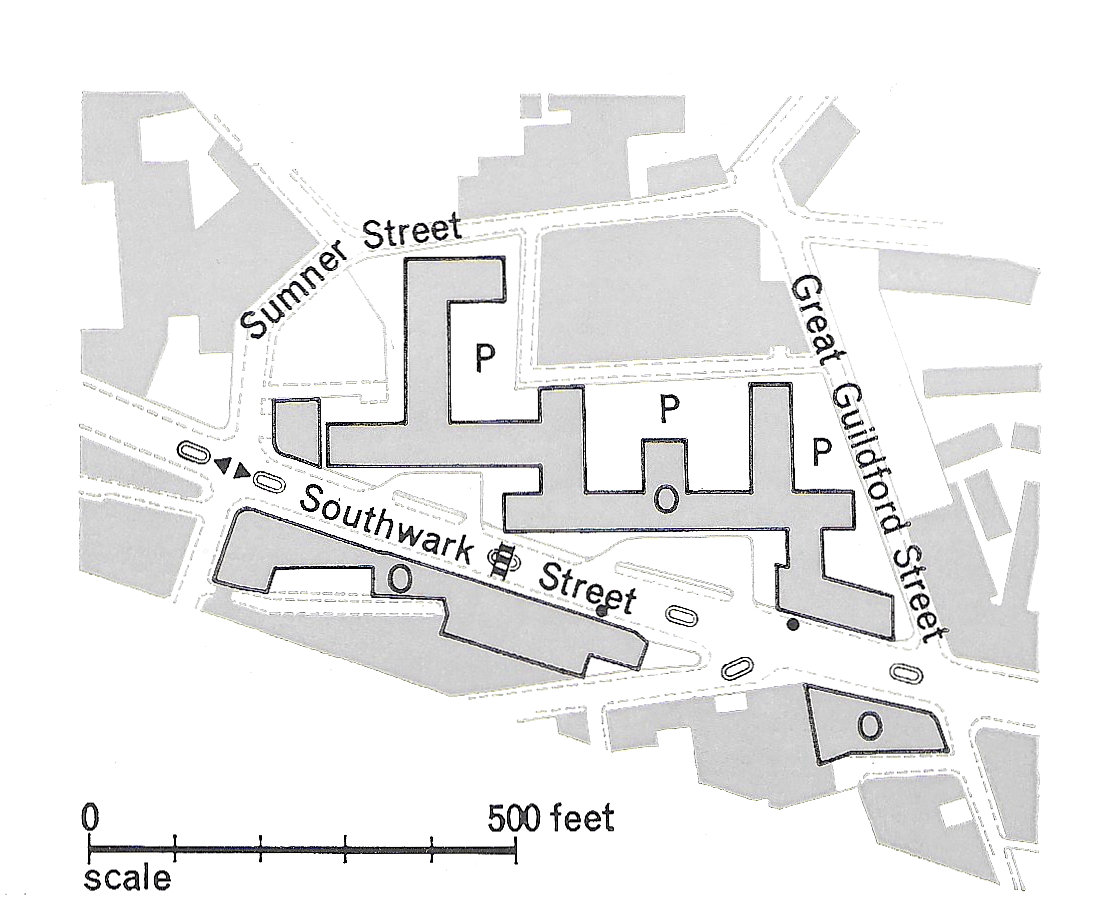
47We concentrated our study on a large recently completed office block on the north side of the road. The general layout is shown in Figure 9. Sound-level recordings were taken over a 24 hour period inside and outside the building at ground, fourth and ninth floor levels. Simultaneous traffic counts were taken in Southwark Street over ten of the daytime hours. The recordings showed that sound levels are approximately the same at ground and fourth floors, but are lower by about 2dBA at the ninth floor. The difference between external and internal readings was found to be about 17–20 dBA for closed windows and 9–10 dBA for open windows. The average hourly sound level readings for the ground and fourth floors, and the traffic flows are shown graphically in Figure 10.
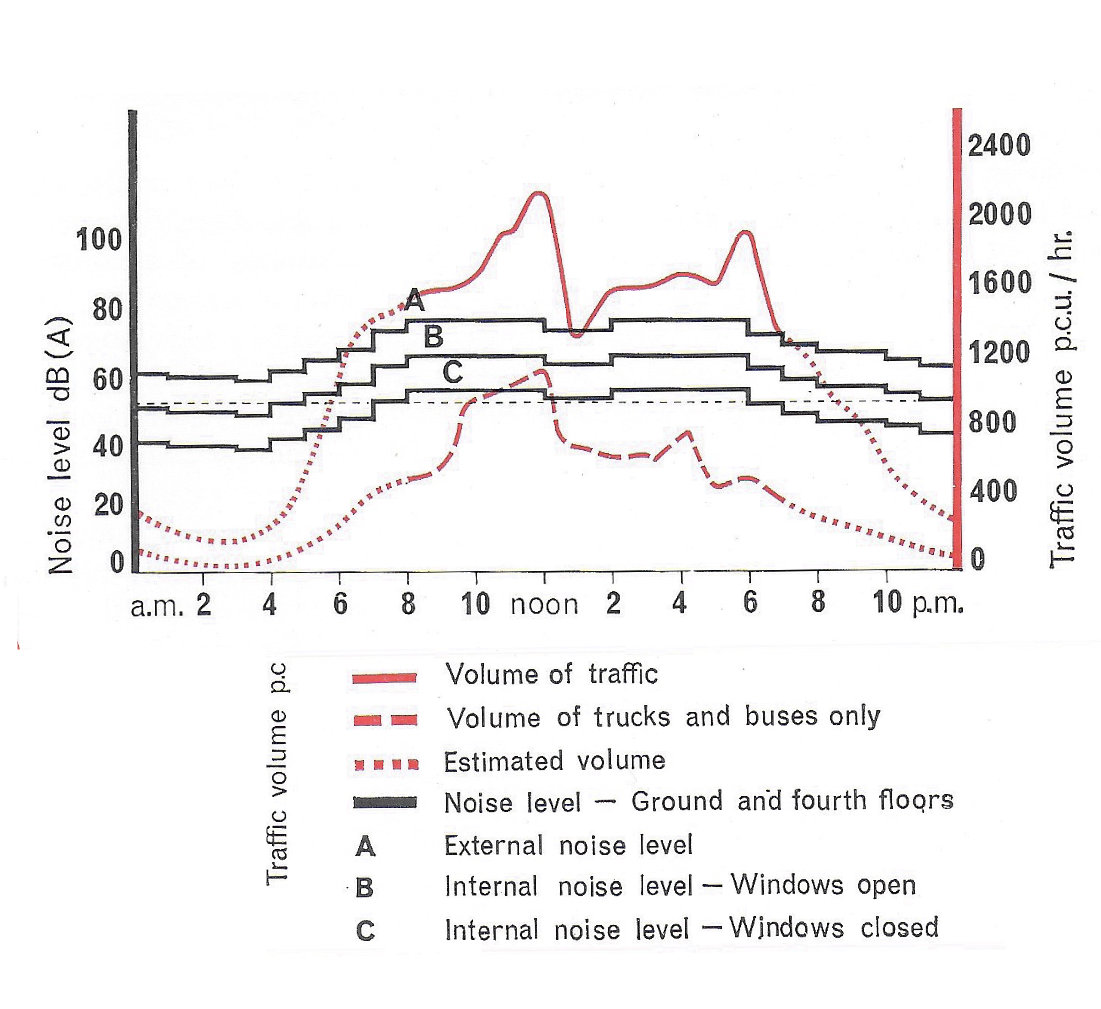
A comparison between traffic volumes and sound levels shows, as might be expected, that the average hourly sound levels are at their highest during the working day when traffic volumes are high and are at their lowest at night when traffic volumes are low. But while traffic flows vary from around 1,500 p.c.u. per hour at 7 a.m. up to 2,200 p.c.u. per hour at noon, and from 1,400 p.c.u. per hour at 1 p.m. to 2,000 p.c.u. per hour at 6 p.m., the average hourly external sound levels remain relatively constant at between 77 and 80 dBA during this period. This suggests that above a traffic flow of around I,500 p.c.u. per hour, increases and changes in the volume of traffic in Southwark Street do not significantly affect noise levels, but that below this flow traffic volume and noise levels are more directly related. The explanation for this may lie in the reduced speeds associated with the heavier traffic flows. In this connection, however, it is worth drawing attention to a passage on sound level and decibels in Appendix II of the Wilson Report, where it is stated that an increase of three decibels in a sound level meter reading corresponds (roughly) with a doubling of the corresponding sound energy wherever it may occur in the scale. In the case of Southwark Street, although traffic flows increased from 1,500 to 2,200 p.c.u. per hour during the morning, this represents only a 50% increase in sound energy (or source) and therefore only very small variations in the sound level meter readings were to be expected.
49Inside a ground floor room with the windows partly open, conversation at normal speech levels between people in the room, or on the telephone, was not possible. With the windows closed, sound levels varied between 57 and 60 dBA during the working day. Conversation could be carried on but individual heavy vehicles sometimes made it difficult to hear. Outside the building at ground level it was impossible to carry on a conversation without raising voices at practically any time between 9 a.m. and 6 p.m. The noise of individual heavy vehicles was particularly noticeable. This impression was confirmed by the sound level recordings, which showed that although the average hourly readings for the ground floor and fourth floor were approximately the same, the range of levels recorded was greater for the ground level, going up to 92 dBA as heavy lorries passed. At the fourth floor the extremes of noise were not quite so apparent, the highest external level recorded being 88 dBA. Conditions inside a room on the fourth floor with the windows partly open were the same as on the ground floor. With windows shut conversation could be carried on but individual heavy vehicles were disturbing. At the ninth floor conversation could not be carried on at normal speech levels with the windows open. With the windows shut, when sound levels varied between 55 and 58 dBA during the working day, conditions for normal speech seemed just about acceptable.
50In the Wilson Report it is suggested that ‘55 dBA should be the upper limit to be tolerated in buildings in which communication by speech is of great importance’. Offices, of course, come within this category. It can thus be seen that below the ninth floor sub-standard conditions exist in virtually all the rooms facing the street in this very sizeable new office building. The conditions are not marginally sub-standard, but quite seriously deficient. Even at the ninth floor it is only by keeping the windows shut that the suggested acceptable sound level is achieved, but, of course, windows cannot be kept shut in a building which has no air conditioning, especially on a south-facing facade. Figure 10 shows that up to the fourth floor the working conditions are acceptable, even with windows shut, only before 7 a.m. or after 6 p.m.
51
This case obviously gives food for very serious thought. The Wilson Report offers little hope that much can be done to reduce the noise of heavy vehicles, nor does it offer much encouragement on the prospect of improving the insulation of buildings except at the expense of modern methods of cladding. Whilst we ourselves are inclined to be more optimistic on both these points, the general lesson is quite plain that it is to the improved planning and siting of buildings in relation to traffic routes that we must look for the main amelioration of traffic noise.

Was this section useful?
Make a donation