Appendix 1: The environmental capacity of streets
Queen Anne's Gate, Westminster: 39–45
Queen Anne’s Gate, Westminster
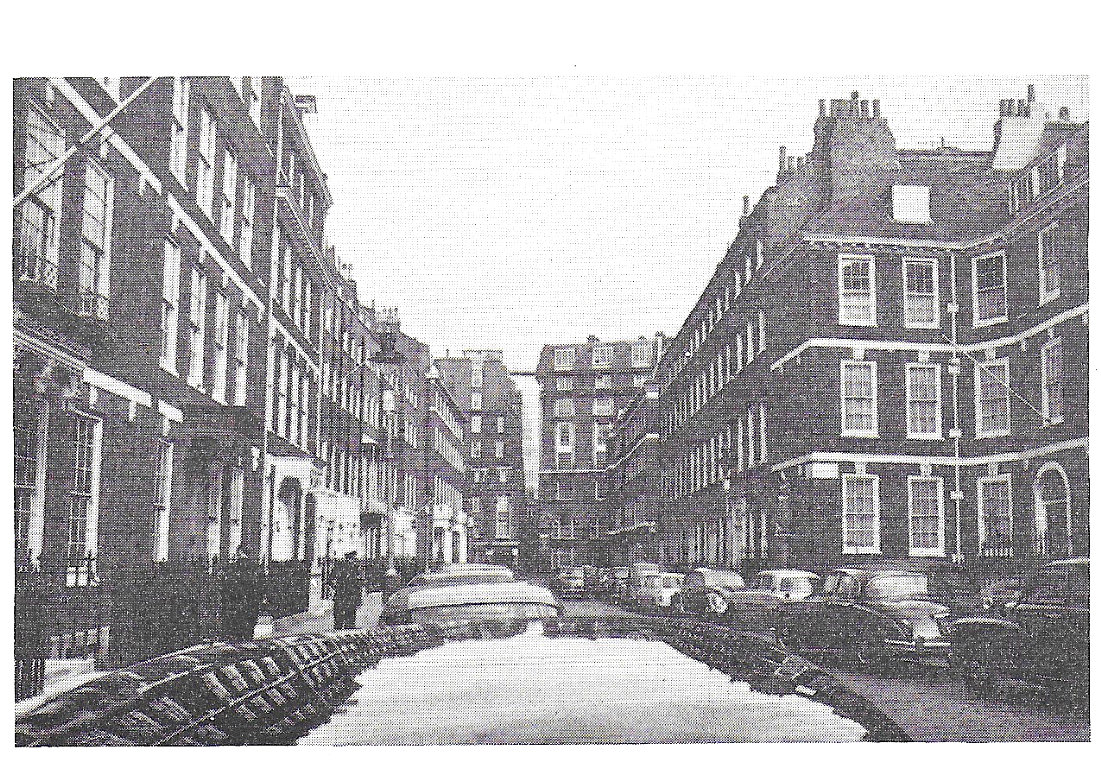
39The layout of Queen Anne’s Gate and the adjoining streets is shown in Figures 7 and 8. The part we were particularly concerned with is the section running parallel to St. James’ Park. This was originally built as two separate closes separated by a wall which was not removed until near the end of the 19th century. The western part was built around 1704. It is of generous width, about 65 ft. between buildings, and contains fine brick houses. The eastern part was built later in the 18th century. It is narrower and of a somewhat different character, but again has fine houses. The street and the buildings as a whole form a group of outstanding architectural interest. The houses are now used almost entirely as offices.
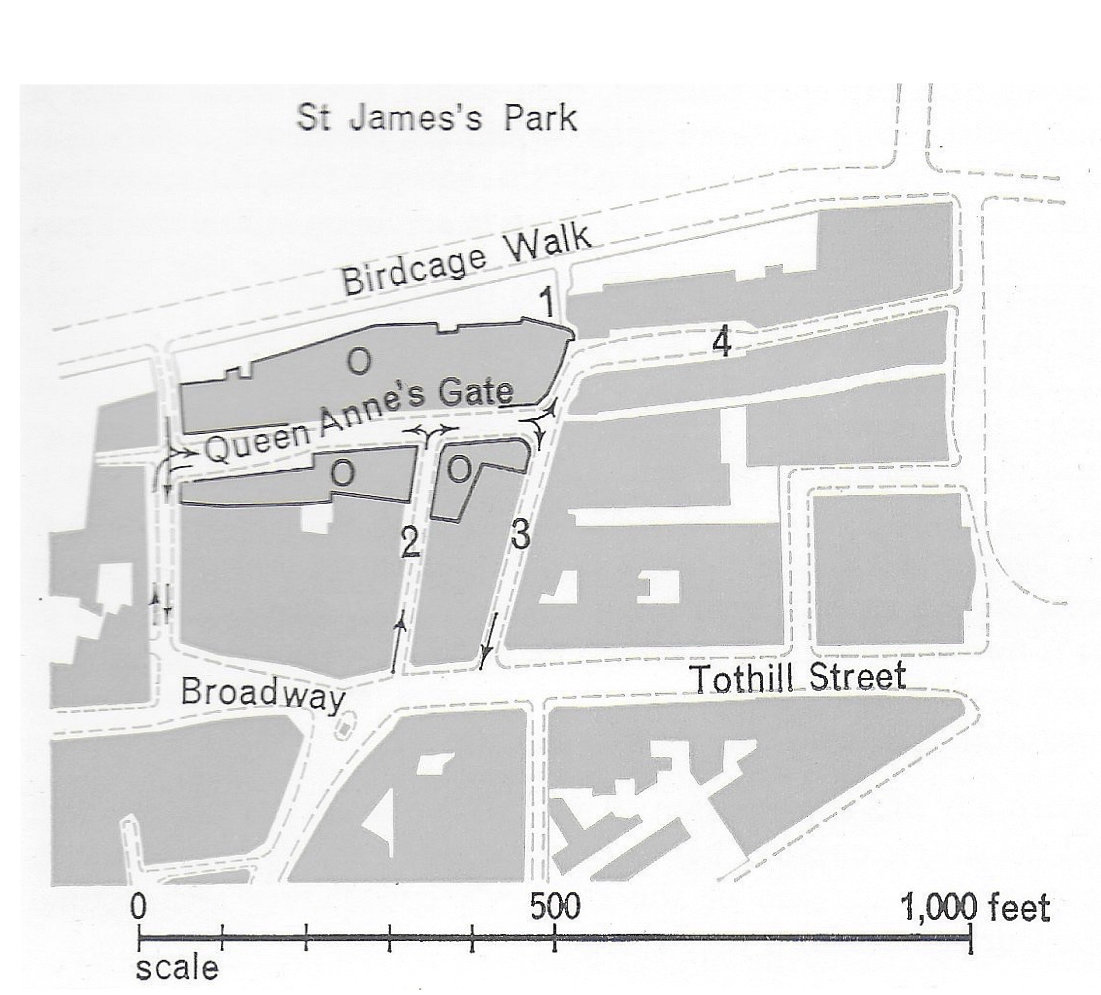
A one-way system operates around these streets as shown on Figure 7. This prevents vehicles from entering Queen Anne’s Gate from either Dartmouth Street or Old Queen Street. As a result the main traffic flow is from west to east. The flow in both directions midway along the street is small, being about 80 v.p.h. during the lunch hour and mid-afternoon, and about 110 v.p.h. from 5 to 6 p.m. About 60% of the total daily flow appears to be through traffic in relation to this section of Queen Anne’s Gate.
41There were no parking restrictions at the time of the study and parked vehicles lined both sides of the street totalling some 65 in all. They appeared to be mainly long term parkers—people who work in Queen Anne's Gate and elsewhere. We understand some people park all day in this street, walking across the Park to their work in the Mayfair meter zone. Long term parkers made difficult or prevented the short term parking of delivery and other service vehicles at the kerbside. As a result double-parking took place, which in the narrow part of the street led at times to congestion.
42The short length of the street and the fairly frequent blockages had the result that vehicles tended to travel slowly, although when the street was clear a few vehicles went through at speed. The traffic flows, however, did not seem to interfere seriously with the freedom of pedestrians to cross the carriageway at will. People even walked on the carriageway, perhaps because of the difficulties of getting access to the pavements through the closely-parked vehicles, and perhaps because the pavement is very narrow at the east end of the street on the south side. There is a marked pedestrian route, used at lunch time and at the end of the day, between Old Queen Street and Cockpit Steps and Carteret Street. This is presumably a route to and from St. James’s Park Station and the shops, restaurants and pubs of Broadway. People were also walking, in their lunch hour, right along Queen Anne's Gate to and from the park.
43Sound level recordings were taken over 24 hours at the kerbside in the narrow part of the street. The average hourly readings were between 63 and 64 dBA during a large part of the working day, falling during the afternoon to between 59 and 6I dBA. Our impression of Queen Anne’s Gate as a reasonably quiet street for offices appears to be confirmed by the recommendation in the Wilson Report that 55 dBA should be the upper limit to be tolerated in buildings in which communication by speech is of great importance. Assuming a difference between external and internal noise readings of 10 dBA for open windows, then sound levels inside rooms in Queen Anne’s Gate, with windows open, would not be above 54 dBA. The traffic flow in Queen Anne’s Gate is so small (80-100 v.p.h.) that the sound level in the street must derive also from the noise in adjoining streets and areas.
44The conclusion in this case is plain. It is that the ‘failure’ of the street is primarily in the impairment of its dignity and character by the presence of vehicles. Parked and double-parked vehicles seem to fill the space between the buildings, the bases of the buildings and the steps and railings cannot be seen, and the relationship between the ‘floor’ and ‘walls’ of the street is destroyed. For those people who wish to enjoy Queen Anne's Gate at leisure, the barrier of vehicles inhibits ease of movement about the street and prevents certain aspects from being enjoyed at all. From this point of view there is no doubt that traffic should be reduced to service vehicles and cars and taxis setting down or picking up passengers, and that there should be no through traffic and no long term parking at all.
45Fundamentally this is a question of values. The street has to be viewed as it is, and the simple question has to be asked whether this is or is not an acceptable treatment for one of the country's outstanding architectural possessions. Our conclusion is that it is not.