Chapter 4: Some lessons from current practice
Central areas: 432–435
In spite of the decay there seems to be no idea of abandoning downtown areas. It is agreed that they still perform certain important functions, though it is recognised that these may have to be different in future.
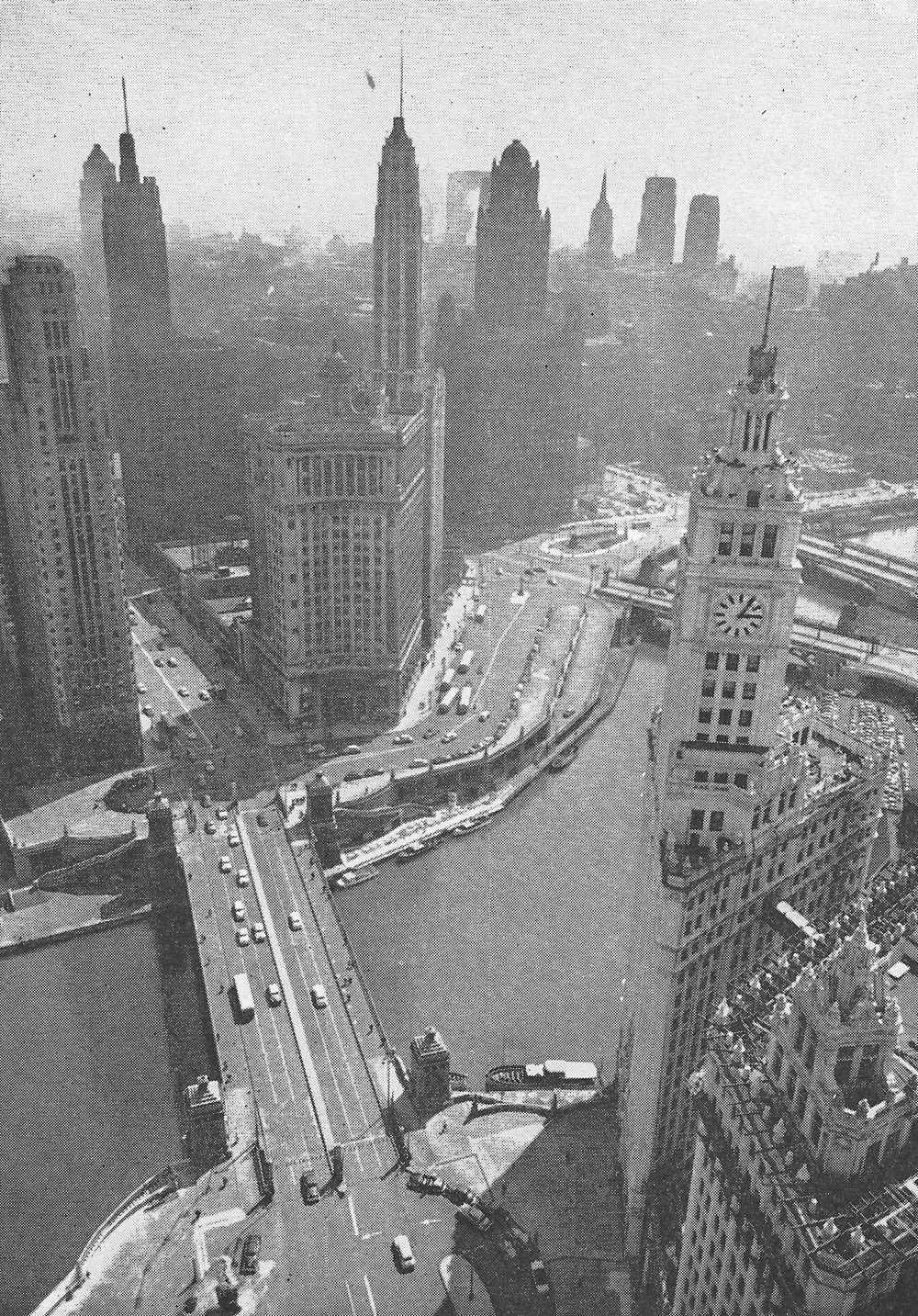
Fig. 246 ‘…down town areas of such intrinsic power and character that they have retained their magnetism.’ (Chicago. Bordering the far side of the river there is another wide highway underneath the road visible in the photograph).
Central areas
432Reference has already been made to the visible physical disintegration which has taken place in the downtown area of Los Angeles, rendering it a depressingly ugly place. The same seems to have happened in many other cities, though others, such as New York (Manhattan), San Francisco and Chicago, have had downtown areas of such intrinsic power and character that they have maintained their magnetism. This decay is indirectly another result of sprawl, it is certainly not a result (as often alleged) of the downtown areas having been ‘carved up by freeways’. Even in Los Angeles the downtown area is enclosed, not cut up, by tangential freeways. In spite of the decay that has taken place there seems to be no idea of abandoning downtown areas. It is widely agreed that they still perform certain important functions, though it is recognised that these may have to be different in future. In Los Angeles the downtown area is seen as a place for Government and financial functions, cultural buildings of various kinds, head offices of business and industrial concerns, shops whose business is too specialised for them to flourish in suburban centres, and a shopping centre for the daytime business population. But it is recognised that many of the former shopping facilities have been transferred to the suburbs for good. This faith in the future of downtown areas is interesting, and relevant to our own position.
433In some cities, vigorous efforts are being made to revitalise downtown areas. Some of this work savours of ‘projectitis’ (to use another American term), that is to say it takes the form of a single building project which, though it may be very large, is not discernibly part of a real attempt to redevelop the whole downtown area. The ‘Mid Town Plaza’ at Rochester in New York State appears to be in this category. This is a single very complex structure consisting of a large covered-in, air-conditioned shopping centre with 65 separate shops, three floors of parking below, and a 13-storey office block on top with a 4-storey hotel on the top again. It is an interesting example of multi-level planning, but whether, by concentrating so much into a single high building, it has helped to prime the redevelopment of the remainder of the downtown area remains to be seen.
434In the centre of Philadelphia, on the other hand, a large scale redevelopment of great significance is taking place. It is a remarkable example of what can be done in the absence of anything resembling the town planning powers that we possess, but with a compensating readiness of owners and developers to accept and work towards an imaginative project. Much of the progress has been attributed to the fact that at the start the designers produced a three-dimensional architectural image of the centre of Philadelphia as it might be, and by keeping it constantly in view they so fired the enthusiasm of the public and developers that a general determination to have it was engendered.
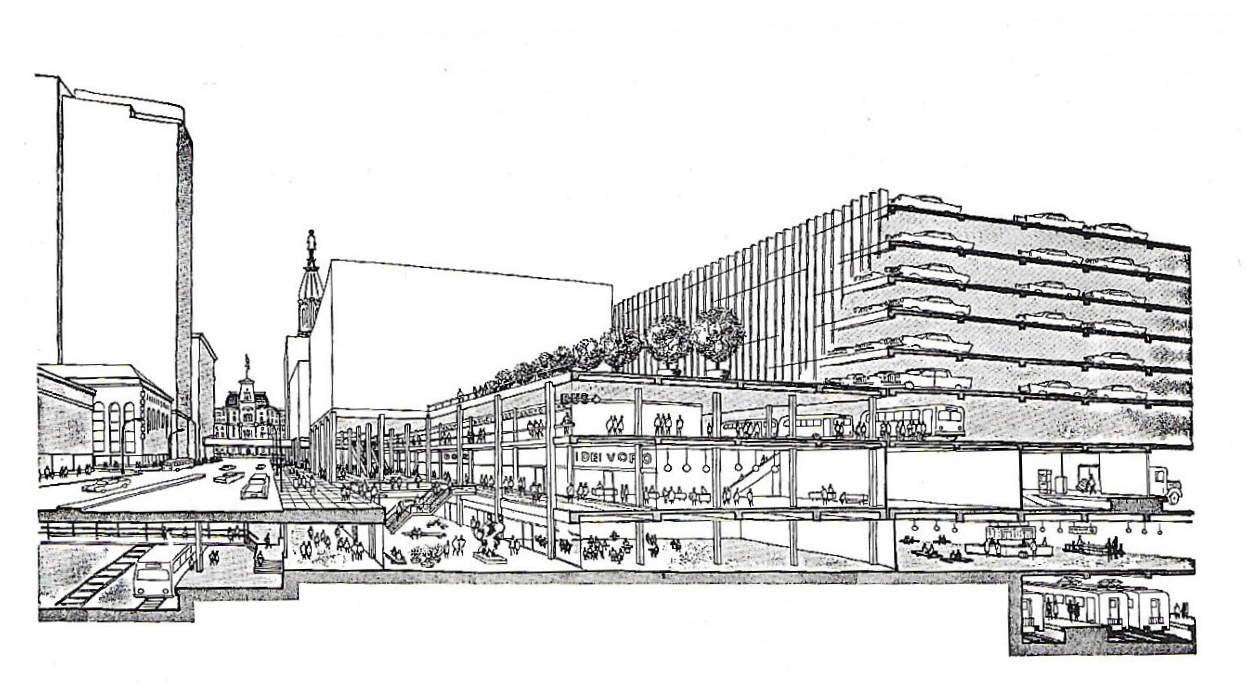
435The great interest of the Philadelphia redevelopment is that it is an advanced example of what has already been termed traffic architecture in this Report. It is not a matter of streets and buildings, but of a great comprehensively-designed multi-level complex of accommodation and access arrangements (Figure 60). But even with this elaborate scheme, the designers have disclosed that questions of space, environment, and practical design, put a limit to the amount of motor traffic that can be accommodated, and this in turn has led to important conclusions about the need to improve public transport.