Chapter 3 – Part four: A central metropolitan block
Conclusion: 366
the area could be made to function reasonably efficiently… with a tolerable environment, but the usage of private cars would be restricted from the very first, and become progressively more and more restricted.
Conclusion
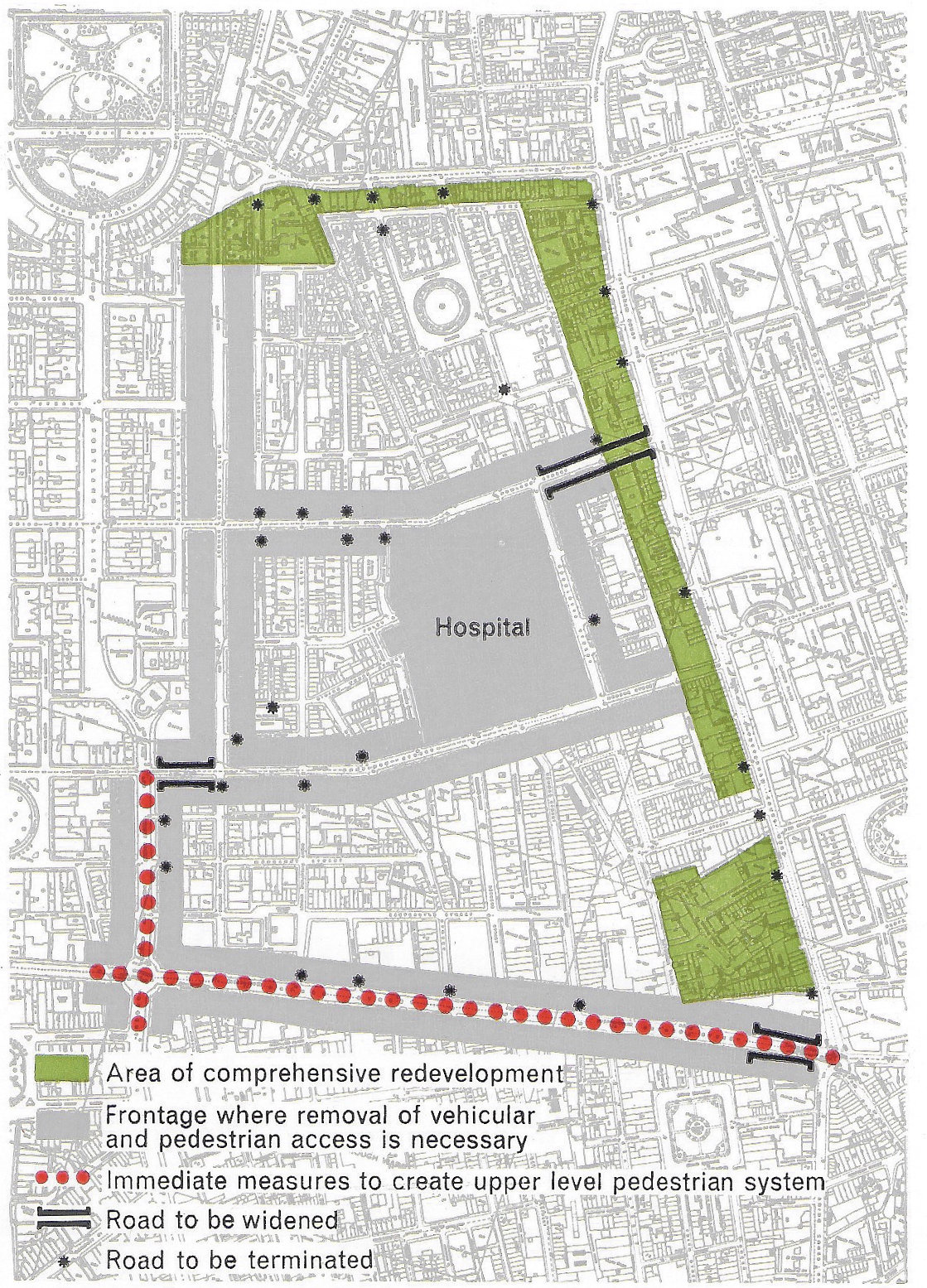
366Our general conclusion from this exercise is that ‘minimum redevelopment’ is a somewhat misleading concept. In fact, even within the modest scheme we have outlined, the amount of redevelopment that would be necessary would be considerable if reasonable environmental conditions are to be established. It would be necessary, first, to redevelop comprehensively the sites adjoining the primary distributors serving the West End (i.e., in relation to the study area, Tottenham Court Road and Euston Road). This would really need to be done at the same time that these roads are converted into primary distributors. Secondly, it would be necessary to hold up the redevelopment of the frontages on other distributors until large enough sites had been secured to make it possible, on redevelopment, to separate vehicles and pedestrians. Thirdly, a major ‘rescue operation’ would be required for Oxford Street. Given all this, the area could be made to function reasonably efficiently and with a tolerable environment, but the usage of private cars (other than for residents) would be restricted from the very first, and would become progressively more and more restricted. (Figure 210)