Chapter III – part three: A historic town
Description of the city: 247–251
Altogether, in the small area of the old city, there are 400 buildings or groups of buildings which have been listed under the Town and Country Planning Act as being of historic or architectural interest
Present conditions
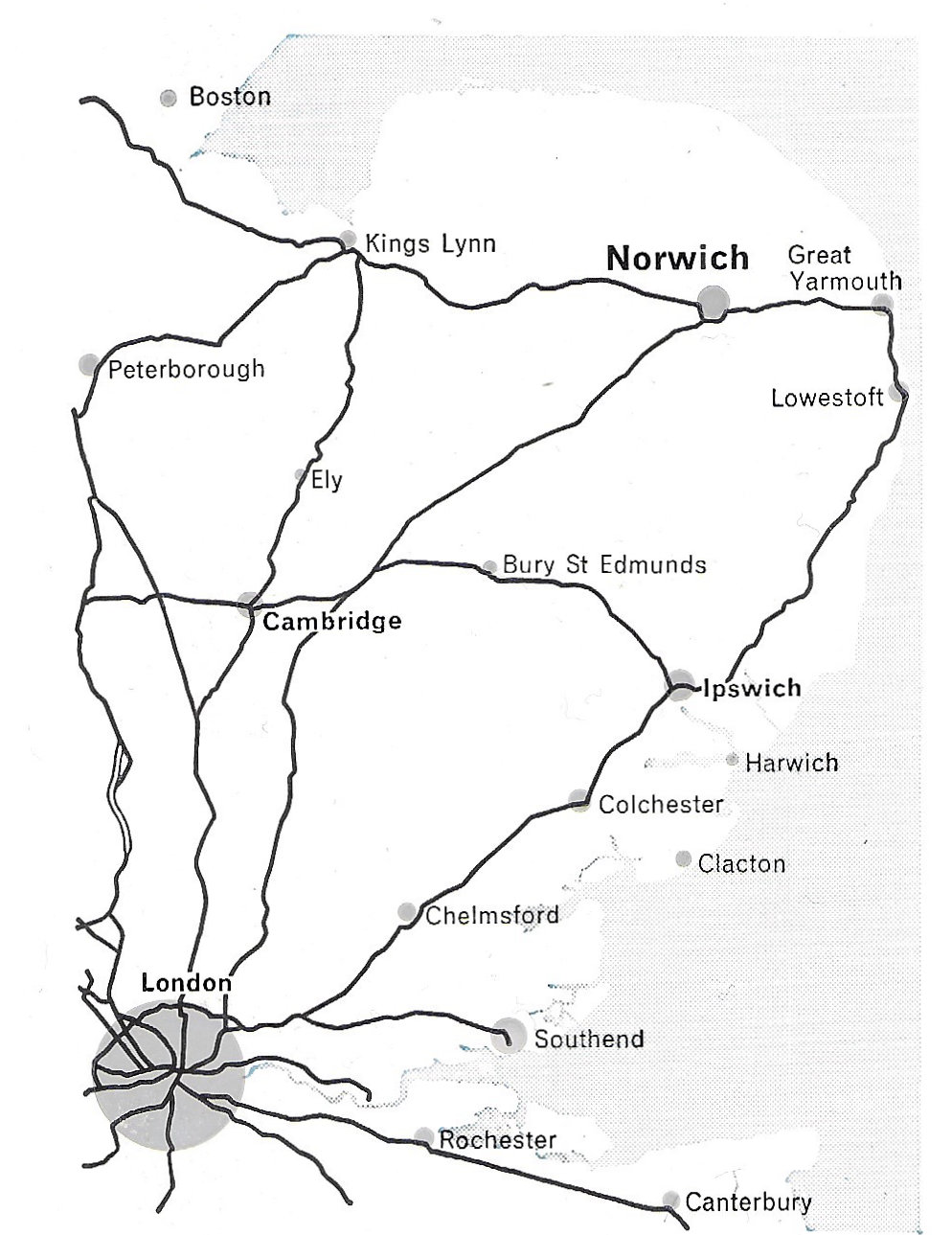
247Norwich is a free-standing cathedral city in an agricultural country-side, and is unrivalled in its dominance of East Anglia. (Figure 144). The population is about 160,000, and is expected to increase to 175,000 during the next 20 years, and may eventually reach 200,000. Figure 146 shows the broad extent of development, with the historic centre and a dozen or so main radial roads.

The main land uses within the historic centre are shown in Figure 147. The area is roughly a mile across, and is enclosed on three sides by the old city wall, and on the fourth by the River Wensum. Traditionally, there is a considerable intermingling of different kinds of uses within the old city. But certain main groups can be identified, such as the two concentrations of industrial uses along the River Wensum, the group of civic buildings around the City Hall, the ecclesiastical area around the Cathedral, and the main shopping centre extending from St. Stephen Street through the Market Place to London Street and Prince of Wales Road.

The main professional, business and administrative activities of Norwich are now concentrated in the old city, together with a large part of the City's manufacturing industry. Much of the former residential use has been displaced, and people have moved out to the suburbs. It is estimated that there are 30,000 to 35,000 persons employed in the old city area, out of a total of 88,000 employed within the Norwich labour exchange area.
250Norwich has had borough status for over a thousand years. The buildings in the old city reflect these centuries of history. There is the Cathedral, the Castle finely situated on a mound, and the modern City Hall. There are more than thirty medieval churches of great interest, the Guildhall, and the remains of the old city wall. Altogether, in the small area of the old city, there are 400 buildings or groups of buildings which have been listed under the Town and Country Planning Act as being of historic or architectural interest. The location of these buildings is shown in Figure 149. Although the buildings are scattered throughout the old city, there are a number of important groups, and in particular there is a unified area comprising the Cathedral, the Close, Tombland, St. Andrew's Plain, Elm Hill and Palace Street where much of the old city remains intact. The medieval street pattern is itself an important part of the City's history. It is complementary to the buildings in scale and provides their setting.
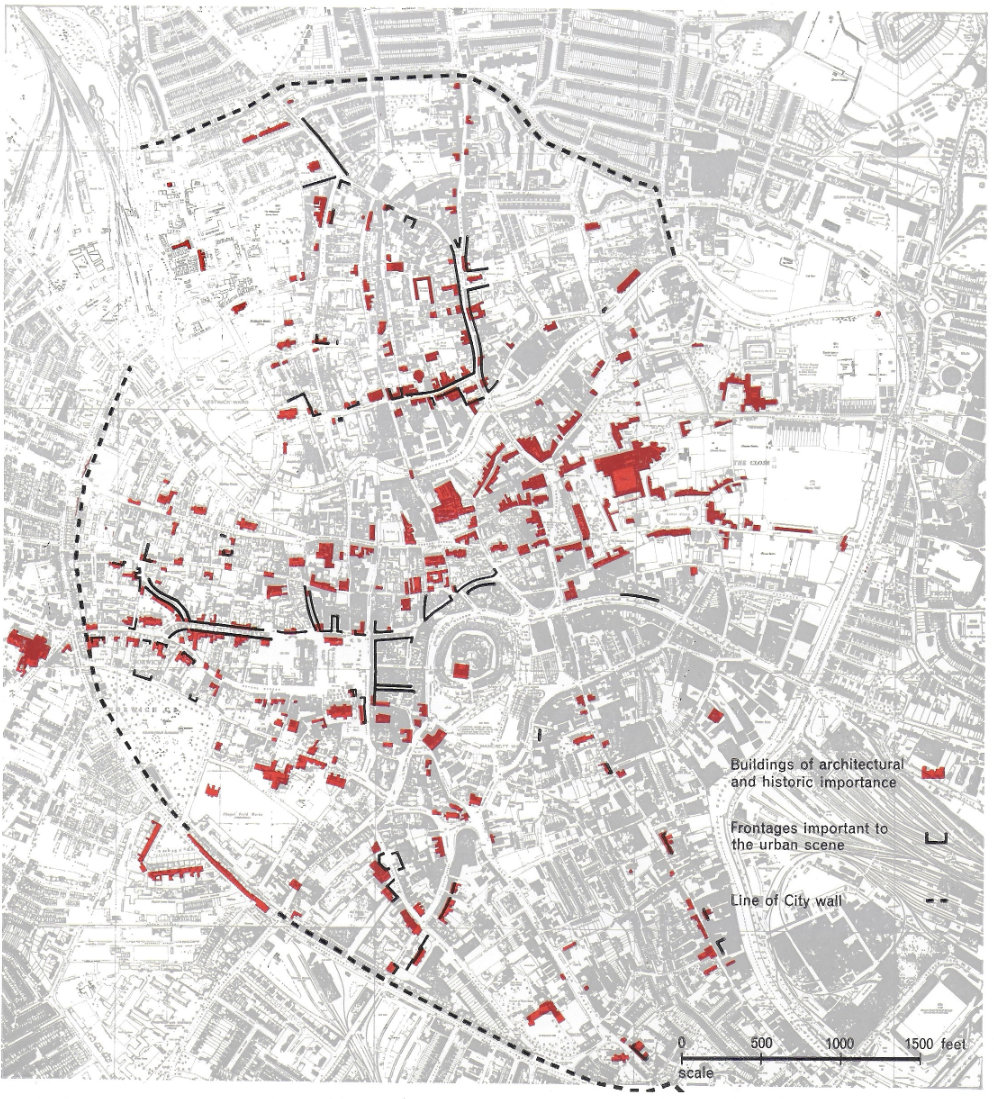
There are also many lengths of building frontage which, while not necessarily including historic buildings, are important to the urban scene and worthy of protection. The more important of these are also shown in Figure 149.