Chapter III – Practical studies
Future increase of traffic: 150
The potential build-up of traffic, as vehicle ownership increases, is far beyond anything that could be accommodated by any adaptations of the existing road system
Future increase of traffic
150We next turned our attention to the future load which the network would have to carry. For this purpose we assumed that vehicle ownership would be approaching the maximum soon after the turn of the century. We also assumed, taking the County Development Plan as a guide, that the population of the built-up area of Newbury and Thatcham would increase to about 37,000 and that the dependent rural population would remain at about its present figure of 30,000. The development plan proposes no drastic changes in the areas or dispositions of homes and workplaces, so we concluded that the desire lines for the year 2010 would not be greatly different in their directions from those shown in Figure 73, but it was obvious that the number of journeys was likely to be dramatically increased.
151
The load which a network has to carry varies in intensity throughout the day. But, as pointed out previously, there are two periods in most towns in the morning and evening respectively, when loads are concentrated, and this is primarily due to the traffic associated with work-journeys. These periods we refer to in this report as the peak period.* The duration of a peak period depends on a number of factors including the overlap that exists between the times at which firms commence or finish work, the relative location of homes and workplaces, and the existence of a state of congestion which may force or encourage a lengthening of the period. In general, in small towns, the peak period tends to be short, perhaps no more than ½ hour, but in larger towns it may extend up to 2 hours or even longer. As a rule the evening peak is more concentrated than the morning peak. To be successful, a network must be able to discharge efficiently the traffic that arises during these peak periods. As far as Newbury is concerned, we have assumed that the desire will remain for the great majority of all work-journeys to take place within a period of one hour. It may be objected that it is extravagant to design for a peak period when there is the alternative of hours of work being deliberately staggered so as to spread the load, but we are inclined to doubt whether there is much chance of any more drastic staggering of hours being acceptable to the public than obtains at present. Indeed, as the standard of living rises, the demand is likely to be increasingly for normal hours of daytime work for as many people as possible. By this reasoning, peak periods are likely to be a permanent feature of life which have to be accepted and designed for. At all events it was the express purpose of this exercise to study the implications of the full use of vehicles without restrictions such as enforced staggering of hours.
*Peak period is to be distinguished from peak hour which is defined in para. 147: The peak hour load is the basis for the technical design of a road system. Peak hours naturally tend to occur during peak periods.
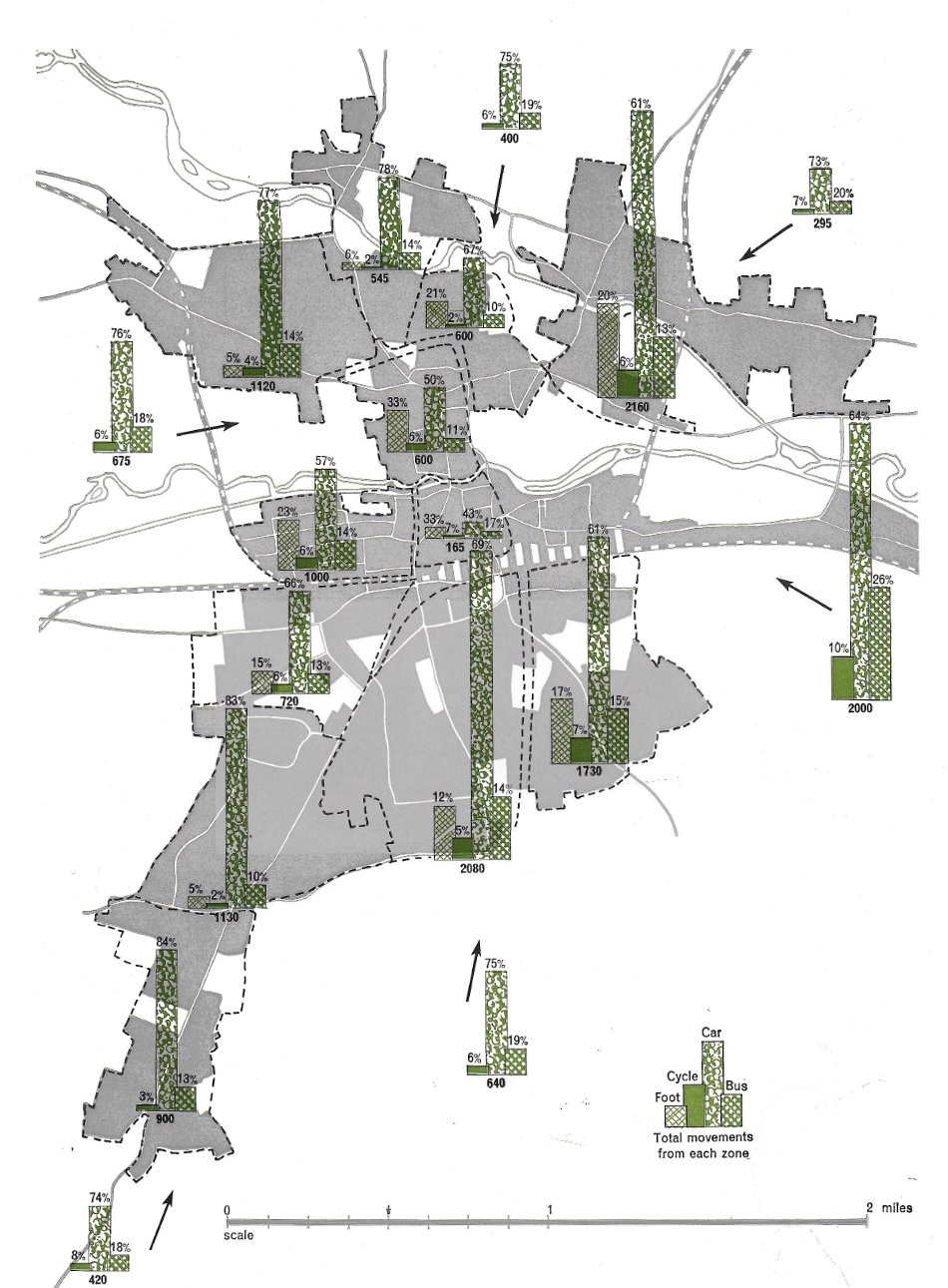
We estimated that the number of cars used for the work journey would rise (given an adequate network and suitable parking places) from about 3,000 to nearly 9,000 (a 200% increase) while the total number of persons travelling to work by all forms of transport would increase only by about 28%. Figure 77 shows the number of journeys from each residential zone, and the main modes of travel likely to be adopted in 2010. This can be compared with the existing modes of travel shown in Figure 74. We did not construct a peak hour flow diagram for the year 2010 on the basis of the existing street system because it was quite obvious that the existing system could not possibly carry the enormously increased loads. We do not think there is any doubt about this at all. The potential build-up of traffic, as vehicle ownership increases, is far beyond anything that could be accommodated by any adaptations of the existing road system. It is not only that the widths and intersections of the existing road system are inadequate, it is the mixture of functions that the roads are called upon to discharge that is an equally serious difficulty. At this point, of course, we might have taken fright, and decided that the restriction of traffic was the only course open, but this would have been contrary to the brief we set ourselves, of demonstrating what is involved in going the whole way with the motor vehicle.